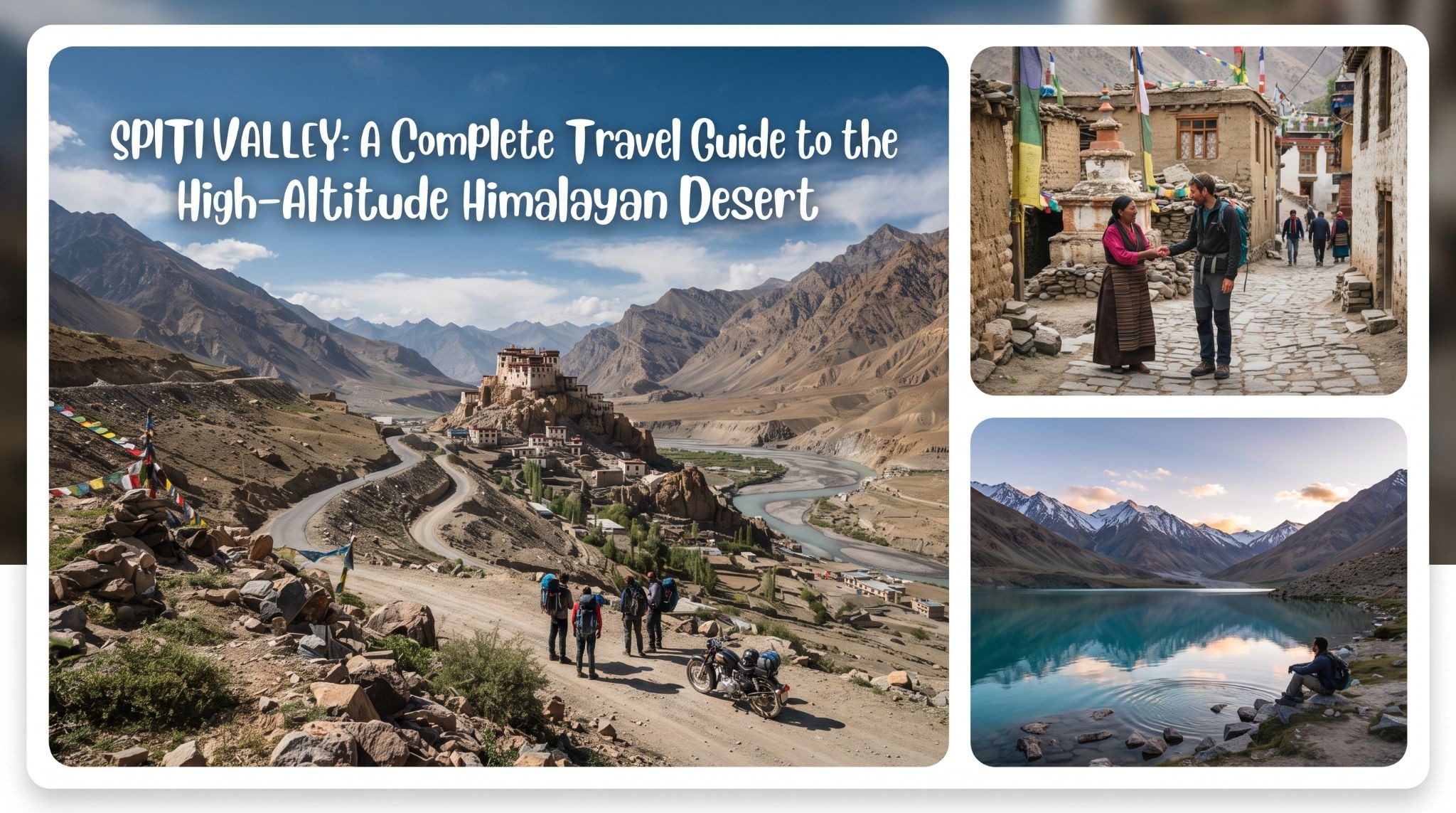
Spiti Valley feels different from the moment the landscape begins to change. Green mountains gradually give way to bare cliffs, wide riverbeds, tiny villages, and enormous stretches of rock under an unusually clear sky. At more than 3,000 metres in much of the valley, this remote corner of Himachal Pradesh combines dramatic scenery with a living Buddhist culture that has shaped everyday life for centuries.
Yet Spiti is not simply a place to collect mountain photographs. The journey is part of the experience, whether you arrive through Kinnaur and Tabo or cross the high passes from Manali. Monasteries, ancient villages, high-altitude landscapes, local food, wildlife and quiet roads all give the valley its character. This guide covers the places worth seeing, the best time to go, ways to reach the region, practical planning advice, and experiences that can make a Spiti trip far more rewarding.
What Makes Spiti Valley Special?
Spiti is often described as a cold desert, but that description only captures its appearance. The valley is shaped by the Spiti River and surrounded by rugged Himalayan terrain, while small green patches around settlements reveal how communities have adapted to an extremely dry, high-altitude environment.
Buddhism is deeply connected with the region. Monasteries, prayer flags, chortens, mani stones and traditional architecture appear throughout the valley. The combination of stark mountains and centuries-old religious traditions creates an atmosphere that is very different from the forested hill stations of Himachal Pradesh.
For travelers, Spiti works particularly well as a slow road-trip destination. There are spectacular viewpoints, but some of the most memorable moments come from simply driving between villages, stopping for tea, watching the light move across the mountains, or exploring a quiet monastery.
The Best Places to Visit in Spiti Valley
The valley has enough attractions to fill several days, with Kaza serving as the practical base for many excursions.
| Place | Why Visit | Ideal For |
| Kaza | Main settlement, markets and access to surrounding villages | First-time visitors |
| Key Monastery | Historic Buddhist monastery with dramatic mountain views | Culture and photography |
| Tabo | Ancient monastery and peaceful village setting | History and heritage |
| Dhankar | Cliffside monastery and spectacular valley scenery | Landscapes and culture |
| Kibber | High-altitude village and wildlife surroundings | Nature and adventure |
| Langza | Mountain scenery, Buddha statue and fossils | Photography and village life |
| Hikkim | High-altitude village experience | Road trips |
| Komic | Remote high-altitude settlement | Landscapes and solitude |
| Pin Valley | Rugged scenery, villages and wildlife habitat | Nature and trekking |
Key Monastery
Key Monastery, also written as Ki or Kye Monastery, is one of the defining sights of Spiti. Built on a hill above the valley, its layered buildings and surrounding mountains make it instantly recognizable.
Inside, visitors can see traditional religious artwork and monastery spaces, while the elevated position provides expansive views across the Spiti landscape. The monastery is about 12 kilometres from Kaza, making it one of the easiest major attractions to include in a local sightseeing day.
Tabo
Tabo has a quieter character. Its monastery was founded in 996 AD and forms one of the most important historic monastic complexes in the region. The complex contains temples, chortens, monk and nun quarters, along with old paintings and sculptures.
The village itself is worth exploring without rushing. Tabo’s dry surroundings, traditional homes and orchards provide a different visual experience from the more dramatic mountains around Kaza.
Dhankar
Dhankar is famous for its monastery perched dramatically above the Spiti River. The location was historically strategic, and the monastery was associated with the former local ruling system. Today, the setting is one of the area’s most memorable combinations of architecture and landscape.
Kaza: The Practical Base for Exploring the Valley
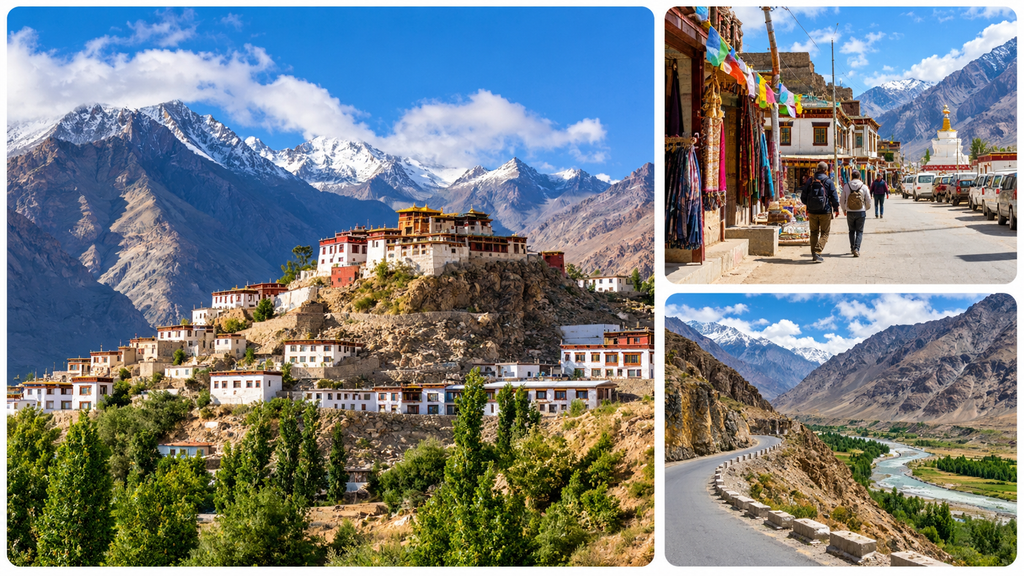
Kaza is the administrative headquarters and largest settlement in Spiti. It is also the most practical base for exploring several nearby attractions.
The town has shops, restaurants and basic services, and it is positioned conveniently for trips toward Key, Kibber, Langza, Hikkim and Komic.
Kaza is not a conventional mountain resort, and that is part of its appeal. The atmosphere is functional rather than luxurious. Travelers usually come here to organize the next day’s journey, eat local food, meet other travelers, or simply adjust to the altitude.
Spending a few nights here can also make the trip less rushed. Rather than treating Kaza as somewhere to sleep between sightseeing drives, use it as a base for exploring the surrounding villages at a comfortable pace.
Langza, Hikkim and Komic: The High-Altitude Villages
The villages around Kaza provide some of Spiti’s most recognizable landscapes.
Langza is known for its large Buddha statue, traditional houses, mountain views and ammonite fossils. The village also has a strong connection with local agriculture and handicrafts.
Hikkim and Komic are often visited together with Langza. Their high-altitude locations and sparse surroundings make the journey itself an attraction.
| Village | Main Character | What to Look For |
| Langza | Scenic traditional village | Buddha statue, fossils, mountain views |
| Hikkim | Remote high-altitude settlement | Village scenery and surrounding peaks |
| Komic | High, isolated Himalayan village | Vast landscapes and traditional homes |
| Kibber | Larger high-altitude settlement | Wildlife habitat and village life |
The best way to experience these villages is not to rush through them for photographs. Walk where visitors are welcome, observe local life respectfully, and remember that these are working communities rather than open-air tourist attractions.
Pin Valley and Its Wild Landscapes
Pin Valley introduces another side of Spiti. The landscape becomes rugged and expansive, with settlements appearing as small green pockets among otherwise dry mountains.
Pin Valley National Park is known for its high-altitude ecosystem and wildlife, including species such as Himalayan ibex, bharal and the elusive snow leopard.
For trekkers, the valley also provides access to challenging routes. These are not casual walks, however. High altitude, changing weather and difficult terrain mean that longer treks require appropriate preparation and physical fitness.
Even travelers who are not interested in trekking can enjoy Pin Valley for its scenery and quieter villages. A road journey through the valley can be enough to appreciate its character.
Chandra Taal and the Manali Side of Spiti
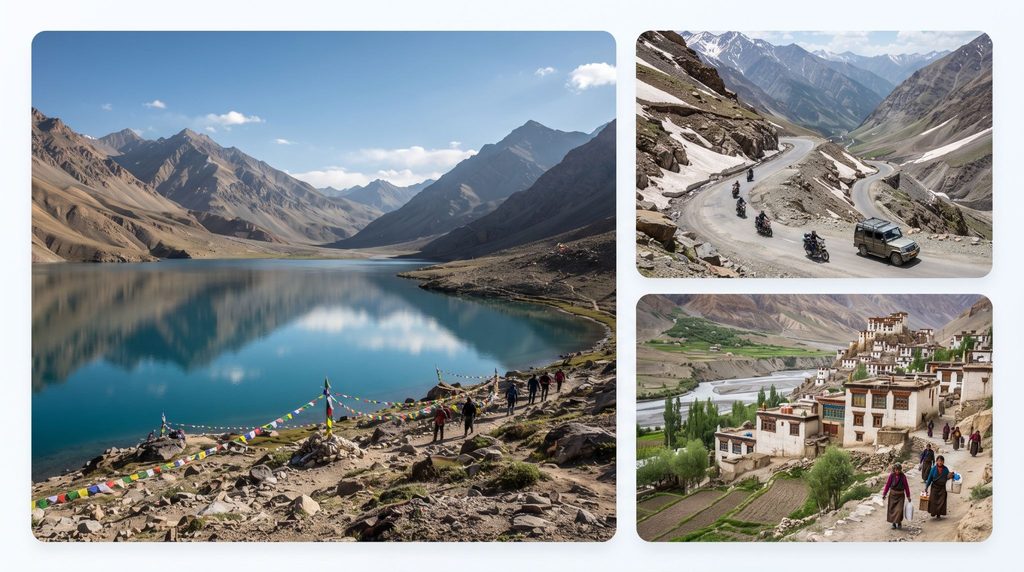
Chandra Taal, meaning “Lake of the Moon,” is one of the most famous landscapes associated with the Spiti region. The crescent-shaped lake sits in a dramatic high-altitude setting near Kunzum Pass.
The lake can be approached from the Manali-Kaza side, with the final approach involving a walk depending on road conditions and access. Himachal Tourism notes that the lake is particularly associated with summer camping and trekking.
Chandra Taal works especially well as part of a broader Manali-to-Spiti journey. Road and weather conditions can change, so travelers should confirm current accessibility before planning the lake as a fixed part of their itinerary.
The Best Time to Visit Spiti Valley
There is no single perfect month for every traveler. The best period depends heavily on the route you want to take and the type of experience you prefer.
Himachal Tourism describes April to October as a generally suitable period for visiting Spiti, while summer provides more comfortable conditions than the deep winter months. Winter can bring severe cold and difficult access.
| Period | General Conditions | Suitable For |
| April–May | Cold, changing conditions; access begins improving | Early-season travelers |
| June–July | More accessible roads and relatively comfortable daytime weather | Road trips and sightseeing |
| August–September | Good balance of accessibility and mountain scenery | General travel |
| October | Colder, quieter, changing conditions | Experienced travelers |
| November–March | Severe winter conditions and difficult access in many areas | Specialized winter travel |
Summer is generally the easiest period for a first trip, but conditions can still change quickly at high altitude. Always check current road status before setting out.
How to Reach Spiti Valley
Spiti is primarily a road-trip destination. There are two principal approaches: from Shimla through Kinnaur and from Manali across the high mountain route.
The Shimla-Kinnaur approach takes travelers through places such as Reckong Peo, Nako and Tabo before reaching the central Spiti Valley. The Manali approach leads toward Kunzum Pass and Kaza when the route is open. Himachal Tourism lists road access from both directions and notes that route availability varies by season.
| Route | Main Approach | Key Consideration |
| Shimla → Kinnaur → Tabo → Kaza | Gradual approach through Kinnaur | Route passes near the Tibetan border |
| Manali → Kunzum Pass → Kaza | High-altitude mountain route | Seasonal road accessibility |
| Air + Road | Fly toward Bhuntar or Shimla, then continue by road | No airport directly serves Spiti |
| Rail + Road | Reach a nearby railhead, then continue by road | The final journey is by road |
For foreign travelers using the Shimla-Kinnaur route, inner-line permit requirements apply because the route approaches the Tibetan border. Indian citizens do not require this permit for entering Spiti, according to Himachal Tourism.
Getting Around Spiti Valley
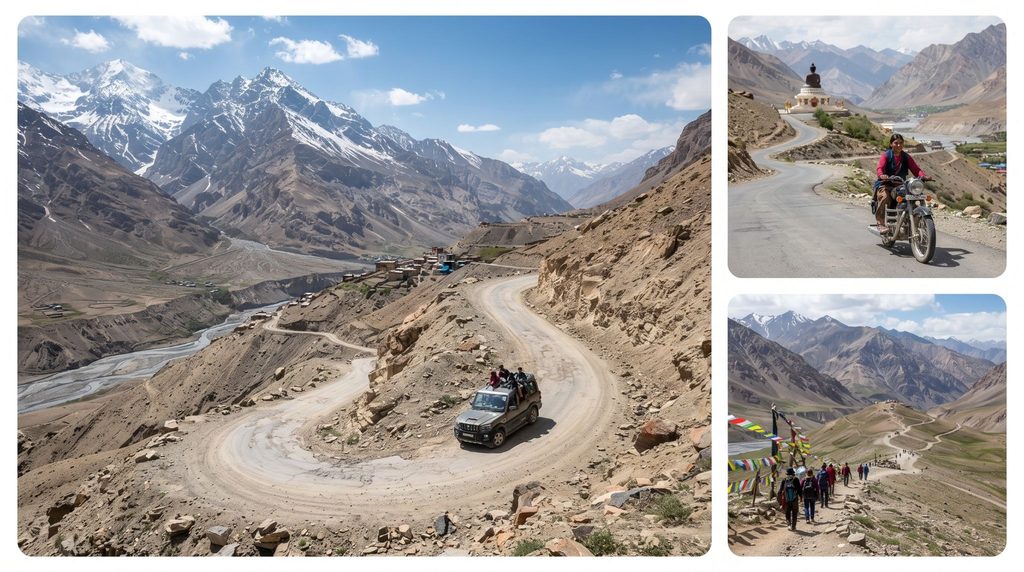
Once inside the valley, transportation requires flexibility. Roads can be rough, distances can take longer than expected, and weather can affect travel plans.
Local taxis and buses are among the practical options. Himachal Tourism recommends sturdy vehicles for journeys from the Manali or Shimla sides.
If you are driving yourself, do not build an itinerary around precise arrival times. Leave room for roadside stops, road conditions and unexpected delays. The journey is one of the reasons to visit Spiti, so a slower schedule usually works better than trying to cover every attraction in a short trip.
Food, Accommodation and Local Life
Food in Spiti reflects the region’s Tibetan and Himalayan influences. Travelers will find dishes such as momos and thukpa, along with local preparations based on barley and roasted flour. Tea is also an important part of the food culture, with options including butter tea and other flavored teas.
Accommodation is generally centered around Kaza and villages along the main routes. Guesthouses and homestays can provide a more intimate connection with local communities than a conventional hotel.
A homestay can also make practical sense because it allows travelers to experience local food and village routines while supporting small community-based businesses. Facilities can be simple, particularly outside Kaza, so travelers should approach village accommodation with realistic expectations.
Culture, Monasteries and Responsible Travel
Spiti’s monasteries are not merely sightseeing attractions. They remain part of a living Buddhist tradition.
Tabo, Key and other monasteries contain religious spaces, artwork and objects that deserve respectful treatment. Visitors should follow local instructions, avoid disturbing prayers or ceremonies, and ask before photographing people or sensitive areas.
The same principle applies to villages. A beautiful house, farm or monastery courtyard may look like a perfect photograph, but it is still part of someone’s home or community.
Traveling responsibly also means carrying waste out of remote areas, avoiding unnecessary plastic, staying on appropriate roads and trails, and treating water and other local resources carefully.
What to Pack for a Spiti Valley Trip
Spiti can be sunny during the day and very cold once the temperature drops, particularly at higher elevations. Himachal Tourism specifically recommends warm clothing because temperatures can change sharply and winter conditions can be severe.
Useful items include:
- Warm layers that can be added or removed easily
- A reliable insulated jacket
- Sunglasses and sunscreen
- Comfortable walking shoes
- A reusable water bottle
- Basic personal medicines
- Power bank and charging cables
- Small snacks for long road journeys
- Cash for places where card or internet connectivity may be limited
- A headlamp or small flashlight
- Copies of important travel documents
Network connectivity is limited in parts of Spiti, and Himachal Tourism notes that connectivity can be unreliable because of the valley’s remoteness and altitude.
A Comfortable Spiti Valley Itinerary
A good itinerary should leave enough time to appreciate the landscape rather than turning every day into a race between viewpoints.
For a first visit, seven to ten days can provide a useful framework, depending on the chosen route and road conditions.
| Day | Suggested Plan | Focus |
| 1 | Reach Tabo or nearby area | Rest and acclimatization |
| 2 | Tabo exploration | Monastery and village |
| 3 | Tabo → Dhankar → Kaza | Heritage and landscapes |
| 4 | Kaza → Key → Kibber | Monastery and high-altitude villages |
| 5 | Kaza → Langza → Hikkim → Komic | Village landscapes |
| 6 | Kaza and nearby surroundings | Flexible exploration |
| 7 | Pin Valley excursion | Nature and villages |
| 8–10 | Continue toward Manali or return via Kinnaur | Road journey |
This is a framework rather than a fixed schedule. Road closures, weather, altitude and seasonal access can require changes.
Photography and Scenic Stops
Spiti is particularly rewarding for landscape photography because its scenery changes dramatically within relatively short distances.
Early and late daylight can emphasize the textures of bare mountains, while villages such as Langza and Kibber provide strong contrasts between cultivated green areas and surrounding dry slopes.
Monasteries also offer architectural subjects, but photography should always be balanced with respect for religious spaces and residents.
Rather than photographing only famous viewpoints, spend time looking for small details: stone walls, prayer flags, traditional windows, mountain roads, cultivated fields and changing shadows across the valley.
Travel Tips for a Safer, More Enjoyable Trip
Altitude is one of the most important considerations when planning Spiti. The valley sits at elevations where some travelers may experience breathlessness, headache, fatigue or other symptoms of altitude sickness.
Take the first part of the journey slowly, stay hydrated and avoid pushing yourself physically immediately after reaching high elevations. If you develop serious or worsening symptoms, seek medical assistance rather than trying to continue the itinerary.
The region also has limited medical infrastructure compared with major cities. Himachal Tourism identifies healthcare facilities in places including Kaza, Tabo and Kibber, but travelers should still carry essential personal medicines and avoid depending on remote areas for specialized treatment.
Most importantly, build flexibility into the trip. In Spiti, a road condition or weather change can matter more than a carefully planned timetable.
FAQs
How many days are enough for Spiti Valley?
Around seven to ten days can work well for a first trip, depending on your starting point, route and how much time you want to spend in villages and surrounding areas. Longer trips allow a slower pace and more flexibility.
Which is the best month to visit Spiti Valley?
June through September is generally convenient for a first visit because summer road access is better and temperatures are more manageable than during winter. Conditions can still vary, so check current road status before traveling.
Is Spiti Valley suitable for first-time mountain travelers?
It can be, provided the trip is planned carefully. High altitude, long road journeys, basic facilities and changing weather make it more demanding than a typical hill-station holiday. A slower itinerary with time for acclimatization is advisable.
Can you visit Spiti Valley without a private car?
Yes. Buses and taxis are available on parts of the route, although services can be seasonal and less frequent than in more accessible tourist destinations. Travelers should confirm current transportation options before departure.
What should I not miss in Spiti Valley?
Key Monastery, Tabo, Dhankar, Kaza, Langza, Hikkim, Komic, Kibber and Pin Valley are among the most notable places to consider. The best selection depends on your route, available time and seasonal road conditions.
Conclusion
Spiti Valley is best experienced as a journey rather than a checklist of attractions. Its enormous landscapes are impressive, but the quieter details often stay with travelers longer: a monastery above the river, a village surrounded by bare mountains, a cup of hot tea after a cold drive, or an unexpectedly peaceful evening in Kaza.
Plan with patience, respect the altitude and leave room for changing conditions. That approach allows the valley to reveal itself gradually—and that slow pace is a large part of what makes Spiti so memorable.
Read More: Solang Valley: Complete Travel Guide, Best Time, Things to Do & Nearby Attractions

I am a travel enthusiast who loves exploring India’s beautiful destinations, culture, history, food, and hidden places. Through my travel website, I aim to help travelers discover amazing places in India and plan memorable trips with useful travel information and tips.