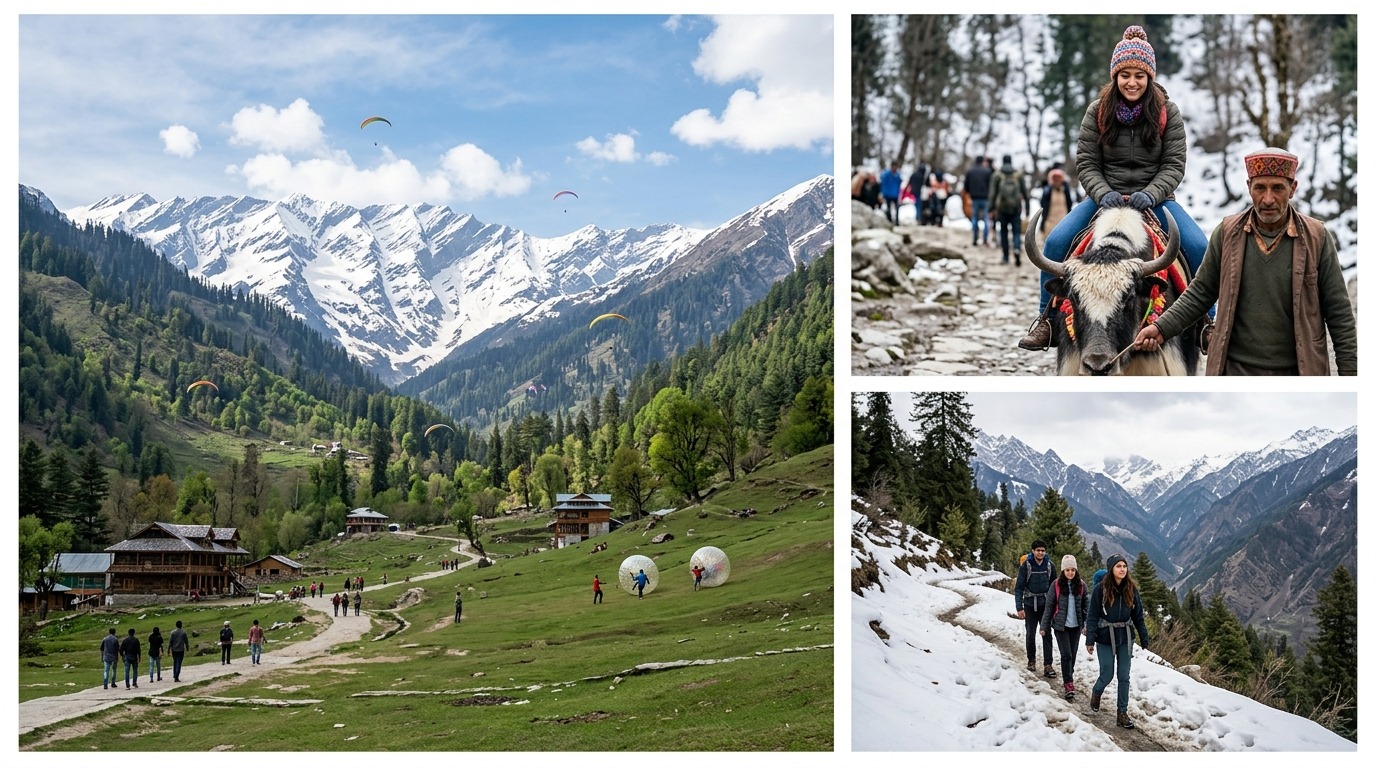
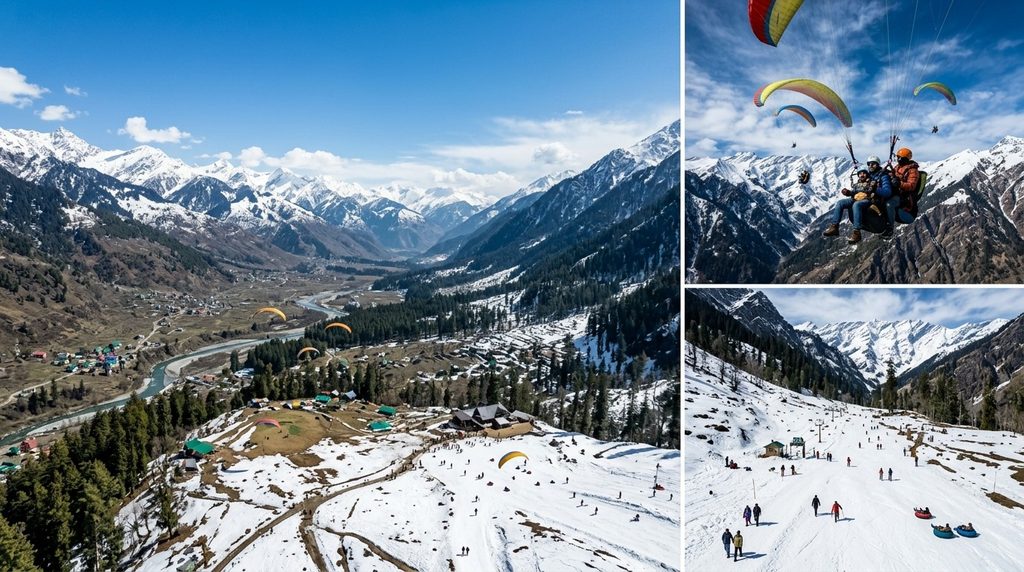
Solang Valley is one of those Himalayan places that feels instantly cinematic. Located about 13 kilometres from Manali, the valley opens into a broad mountain meadow surrounded by deodar-covered slopes and high peaks. In winter, snow can transform the landscape into a popular winter-sports destination, while the warmer months reveal green slopes, clear mountain scenery and a different side of the valley. Himachal Tourism describes Solang Nullah as an open meadow along a forested slope and one of the attractive spots on the outskirts of Manali.
What makes Solang Valley particularly appealing is its changing character through the year. A winter visit can revolve around snow-covered landscapes and skiing, while summer and autumn bring opportunities to appreciate the scenery, explore the mountain environment and discover the wider Manali region. Whether you are visiting as part of a family holiday, a couple’s Himalayan escape or a longer Himachal road trip, Solang Valley is best experienced at a relaxed pace, with enough time to appreciate both the landscape and the journey around it.
Solang Valley Location and Mountain Setting
Solang Valley lies in Himachal Pradesh’s Kullu region, close to Manali. Himachal Tourism places it approximately 13 kilometres from Manali, making it an easy addition to a Manali itinerary.
The valley is surrounded by mountain slopes and dense deodar vegetation, creating the kind of landscape visitors often associate with the western Himalayas. Unlike a tightly enclosed mountain settlement, Solang has a relatively open meadow-like character. This gives travellers broad views of the surrounding terrain and makes the changing landscape particularly noticeable.
The name Solang is commonly associated with the valley’s local landscape, while the term “Solang Nullah” is also used by tourism authorities for the area. The word nullah broadly refers to a mountain stream or watercourse, reflecting the geography of Himalayan valleys.
The short distance from Manali makes Solang particularly convenient for travellers who want to experience a mountain landscape without committing to a remote multi-day journey.
| Travel Detail | Information |
| Location | Near Manali, Himachal Pradesh |
| Distance from Manali | About 13 km |
| Landscape | Mountain meadow and forested slopes |
| Region | Kullu Valley |
| Main seasonal appeal | Snow in winter; greenery and mountain scenery in warmer months |
| Major nearby destination | Manali |
The hill setting also means the valley can feel quite different from the busier streets of Manali. Once the built-up areas give way to open slopes and forest, the journey itself becomes part of the experience.
Solang Valley Through the Seasons
Solang Valley does not have one fixed personality throughout the year. Its appearance and activities change with the mountain climate.
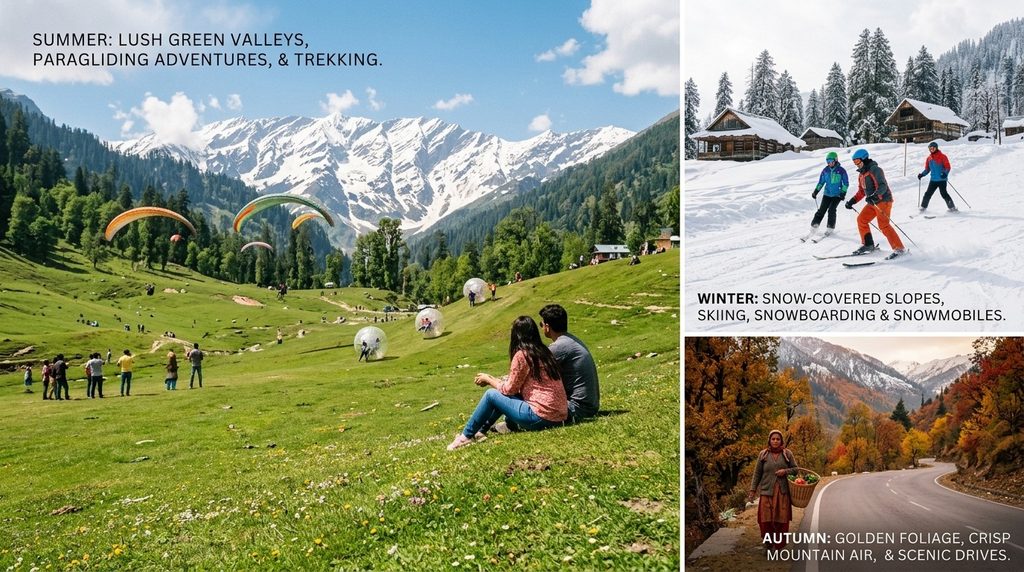
Winter is associated with snow and skiing, provided snowfall and local conditions are suitable. Spring marks the transition from snowy slopes to greener terrain. Summer brings open meadows, forested hills and a wider range of outdoor recreation, while autumn offers a calmer mountain atmosphere before winter returns.
This seasonal contrast is one of the valley’s greatest strengths. A traveller returning at a different time of year may find the same landscape almost unrecognisable.
| Season | Typical Character | Main Appeal |
| Winter | Snow-covered slopes when conditions permit | Snow scenery and skiing |
| Spring | Gradual snowmelt and fresh greenery | Transitional landscapes |
| Summer | Green meadows and forested hills | Sightseeing and outdoor recreation |
| Autumn | Clear mountain scenery and changing vegetation | Photography and quieter exploration |
Seasonal conditions can vary from year to year, so travellers should check current weather, road conditions and activity availability rather than relying solely on typical seasonal patterns.
Solang Valley Winter Experience and Snow
Winter gives Solang its most recognisable appearance. When snowfall covers the meadow and surrounding slopes, the valley takes on a distinctly alpine character.
Skiing is one of the area’s established winter attractions. Himachal Tourism identifies Solang as a winter sports destination and notes that its slopes have hosted skiing championships.
The appeal is not limited to skiing. Travellers who simply want to experience a Himalayan snow landscape can spend time taking in the views, photographing the mountains and enjoying the atmosphere of the valley.
Winter visits do require more preparation than trips during the warmer months. Snow can affect roads and local transport, while activity schedules may change according to conditions. If snow is the main purpose of your trip, check recent local reports before setting out.
The valley is particularly photogenic after fresh snowfall, when the white landscape contrasts with dark deodar forests and surrounding peaks.
Solang Valley Summer Landscape and Outdoor Experiences
Once the winter snow retreats, Solang becomes a greener and more open landscape. The meadow, forested slopes and mountain backdrop create a setting that is well suited to sightseeing.
Himachal Tourism lists several activities associated with Solang during the warmer period, including paragliding, zorbing, rock climbing, camping, mountaineering and ropeway rides.
Availability varies, so visitors should confirm current operating arrangements before planning their day around a particular activity.
For travellers who are less interested in adventure sports, summer is still an excellent time to appreciate the valley. Walking through the open landscape, taking photographs and enjoying the mountain views can easily fill several hours without the need for a packed activity schedule.
The warmer season also makes Solang a useful base for exploring other destinations along the Manali–Rohtang route.
Solang Valley Best Time to Visit
There is no single best month for every traveller. The right timing depends on what you want from the trip.
Choose winter if snow is the priority. The exact amount of snowfall varies each year, so confirm current conditions before travelling.
Choose the warmer months for green landscapes and outdoor sightseeing. This is when the valley’s meadow and forest setting becomes particularly prominent.
Consider autumn for scenic travel and photography. The period can offer a quieter mountain experience and clear views before winter conditions return.
If you are combining Solang with higher-altitude destinations, check road access separately. Mountain routes can have different seasonal conditions from the valley itself.
Himachal Tourism notes that the state experiences substantial seasonal variation, with winter bringing snowfall to many mountain areas and summer offering greener conditions.
Rather than choosing dates solely because they are considered “peak season,” think about the landscape you want to see and the activities that matter most to you.
Solang Valley Adventure Activities
Adventure tourism is a major part of Solang’s modern identity. The official Manali tourism page lists activities such as paragliding, skiing, zorbing, quad-bike rides, rock climbing, camping and ropeway rides in connection with the valley.
The available experiences depend on the season and local operating arrangements. Skiing, for example, depends on suitable snow, while other activities are more commonly associated with snow-free months.
Visitors should select activities through legitimate local operators and follow the safety requirements provided at the time. Mountain conditions can change quickly, and an activity advertised online may not necessarily be operating when you arrive.
It is also worth remembering that adventure sports are optional. Families, photographers and travellers interested in nature can enjoy Solang without participating in organised activities.
Solang Valley Ropeway and Panoramic Views
The ropeway is one of the recognisable features of Solang’s tourism landscape. Himachal Tourism includes a gondola or ropeway ride among the experiences associated with the valley.
An elevated viewpoint changes the way the landscape is perceived. From above, the open meadow becomes part of a much larger mountain scene, with forested slopes and distant peaks extending beyond the immediate tourist area.
The aerial perspective can be particularly impressive when the valley is covered in snow, but the green-season landscape also offers wide views.
For photographers, higher viewpoints provide opportunities to frame the valley as a whole rather than focusing on individual attractions.
Operations can depend on local conditions, so visitors should check current access information before planning around the ropeway.
Solang Valley as a Base for Himalayan Exploration
Solang is more than a sightseeing meadow. Its position near Manali places it within a wider network of mountain routes and excursions.
Himachal Tourism identifies Solang as a base for mountaineering expeditions towards places including Anjani Mahadev, Hanuman Tibba and Patalsu Peak.
For experienced mountain travellers, this gives the area significance beyond conventional tourism. For holidaymakers, the same geography means that Solang can be combined with several nearby destinations.
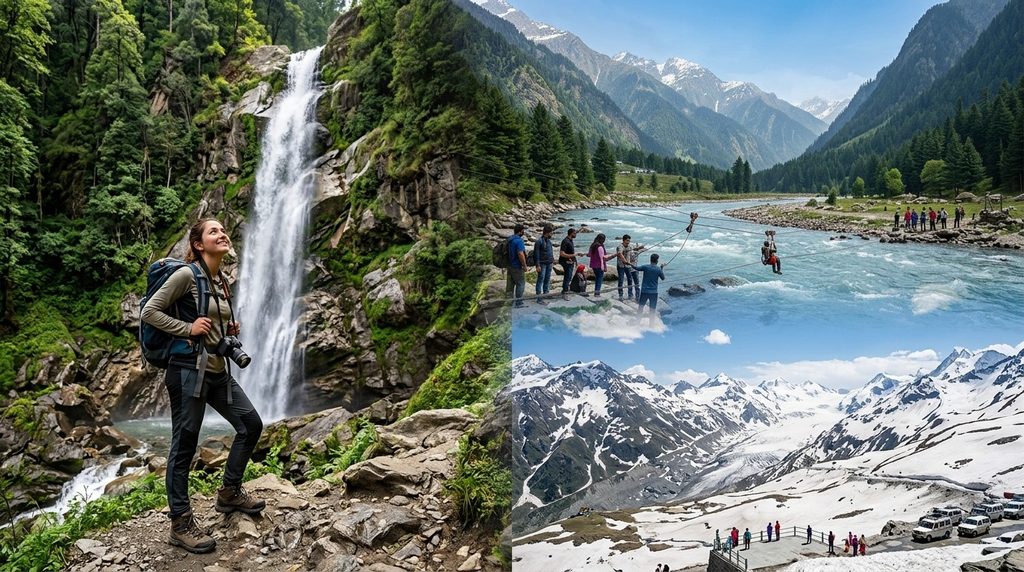
Nearby places include Nehru Kund, Kothi, Rahala Waterfalls and Rohtang Pass. Himachal Tourism places Kothi around 12 kilometres from Manali, Rahala Waterfalls around 16 kilometres and Rohtang Pass around 51 kilometres from Manali.
Rohtang Pass access is regulated, and the tourism department notes that permits are required for tourism visits by petrol and diesel vehicles.
Solang Valley Nearby Attractions
A trip to Solang becomes more rewarding when combined with other attractions around Manali.
Manali is the natural base for most visitors. The town offers accommodation, restaurants, shopping and access to attractions such as Hidimba Devi Temple and Manu Temple. Himachal Tourism describes Hidimba Devi Temple as a 16th-century structure surrounded by deodar trees.
Nehru Kund offers a quieter natural stop close to Manali and is easy to combine with a Solang excursion.
Kothi lies along the route towards the higher mountains and offers broad views of the surrounding landscape.
Rahala Waterfalls adds a waterfall stop to the itinerary and can be especially appealing when water flow is strong.
Rohtang Pass is a major high-altitude attraction farther along the route. Access is seasonal and regulated, so it should be planned separately rather than assumed to be available on every trip.
| Nearby Place | Approximate Distance from Manali | Main Attraction |
| Solang Valley | 13 km | Mountain meadow and seasonal activities |
| Kothi | 12 km | Mountain scenery |
| Nehru Kund | 5 km | Natural spring and valley views |
| Rahala Waterfalls | 16 km | Waterfall and mountain landscape |
| Rohtang Pass | 51 km | High-altitude mountain scenery |
Distances are approximate and can vary according to the exact starting point and road conditions.
Solang Valley How to Reach
For most travellers, the easiest way to reach Solang is by road from Manali.
Because the valley is only about 13 kilometres from Manali, visitors staying in town can generally include it as a half-day or full-day excursion.
Travellers arriving from outside Himachal Pradesh commonly reach Manali through the wider Kullu region. Himachal Tourism identifies Bhuntar-Kullu Airport as the air gateway for the Kullu-Manali region.
Road travel is particularly useful because many nearby attractions are spread along mountain routes. A private vehicle, taxi or suitable local transport makes it easier to combine Solang with other stops.
There is no railway station at Solang itself. Travellers using rail services need to continue by road after reaching a suitable rail-connected destination.
| Travel Option | Practical Route | Best Suited For |
| Road from Manali | Manali to Solang | Most visitors |
| Air | Fly towards Kullu-Manali region, then continue by road | Travellers from distant cities |
| Train + Road | Reach a suitable railhead, then continue by road | Rail-focused journeys |
| Local excursion | Stay in Manali and visit Solang for the day | Short holidays |
Mountain travel times can be affected by traffic, road conditions and weather, so keeping some flexibility in the schedule is sensible.
Solang Valley Where to Stay and How Long to Visit
Most travellers can comfortably visit Solang while staying in Manali. This is often the simplest arrangement because Manali has a wider range of accommodation, restaurants and tourist services.
A one-day excursion is enough for visitors who mainly want to see the valley, enjoy the scenery and experience selected activities.
Two days make more sense if Solang is part of a slower Himalayan itinerary and you want to combine it with nearby attractions without constantly watching the clock.
Staying closer to the valley can provide a quieter mountain atmosphere, but the practical choice depends on your transport plans and the rest of your itinerary.
During busy holiday periods, accommodation in the wider Manali area can be in high demand. Booking ahead is useful when your travel dates are fixed.
Solang Valley Travel Tips for First-Time Visitors
A little preparation can make the trip considerably smoother.
Dress according to the conditions on your travel date. Winter requires substantially warmer clothing, while sunny days in other seasons can still feel intense at higher elevations.
Wear comfortable footwear because the experience involves spending time outdoors rather than simply viewing the valley from a vehicle.
Check road conditions before leaving Manali, particularly after significant snowfall or heavy rain.
If you are visiting for a specific activity, confirm that it is operating before making it the centrepiece of your day.
Avoid packing too many destinations into a single schedule. Mountain roads can take longer than expected, and traffic or road restrictions may alter travel times.
Respect the landscape by avoiding litter, staying on appropriate paths and leaving natural surroundings undisturbed.
It is also worth allowing yourself some unplanned time. Solang is a destination where a quiet viewpoint or an unexpected change in mountain light can become one of the highlights of the visit.
Solang Valley One-Day Itinerary
A simple itinerary can make a visit feel much less rushed.
Start from Manali in the morning and travel towards Solang while the surrounding mountains are clearly visible. Spend the first part of the visit exploring the meadow and taking in the landscape.
If seasonal activities are available and you have chosen to participate, allow time for them without filling the entire schedule.
Take a relaxed break around midday rather than moving immediately from one attraction to another.
In the afternoon, explore the surrounding viewpoints and enjoy the changing mountain scenery. This can also be a good time for landscape photography.
Return towards Manali later in the day and consider stopping at another nearby attraction if road and daylight conditions allow.
For a winter visit, keep the schedule flexible. For a warmer-season trip, you can generally devote more time to sightseeing around the valley and nearby routes.
The goal should be to experience the landscape rather than simply collect photographs from several viewpoints.
FAQs
Why is Solang Valley famous?
Solang Valley is famous for its scenic Himalayan setting near Manali, seasonal snowfall, winter sports and outdoor tourism activities. It is also known for its open meadow, deodar forests and surrounding mountain views.
What is the best time to visit Solang Valley?
The best time depends on your preferred experience. Winter is generally chosen for snow and skiing when conditions permit, while the warmer months are better suited to green landscapes, sightseeing and outdoor recreation.
How far is Solang Valley from Manali?
Solang Valley is approximately 13 kilometres from Manali according to Himachal Tourism. Its short distance makes it one of the easiest mountain excursions to add to a Manali holiday.
What can you do in Solang Valley?
Depending on the season and local operating conditions, visitors can enjoy mountain sightseeing, skiing, ropeway rides and various outdoor recreational activities. Activities associated with the area include paragliding, zorbing, rock climbing, camping and mountaineering.
Can Solang Valley be visited as a day trip from Manali?
Yes. Because the valley is only about 13 kilometres from Manali, it is well suited to a day trip. Travellers with more time can combine it with nearby places such as Kothi, Nehru Kund or Rahala Waterfalls.
Conclusion
Solang Valley captures a particularly beautiful side of the Manali region, where open mountain meadows meet dense deodar forests and dramatic Himalayan slopes. Its appeal changes throughout the year, giving travellers very different experiences depending on when they visit. The valley’s close proximity to Manali also makes it accessible without sacrificing the feeling of being surrounded by mountains.
The best way to experience Solang is to leave room for the landscape itself. Activities can add excitement, but the wide valley, forested hills, changing light and distant peaks are what give the destination its lasting character. Whether included in a short Manali holiday or a longer Himachal Pradesh journey, Solang Valley offers a memorable introduction to the natural beauty of the western Himalayas.
Read More:Holy Places Around the World: Sacred Destinations for a Meaningful Journey

I am a travel enthusiast who loves exploring India’s beautiful destinations, culture, history, food, and hidden places. Through my travel website, I aim to help travelers discover amazing places in India and plan memorable trips with useful travel information and tips.