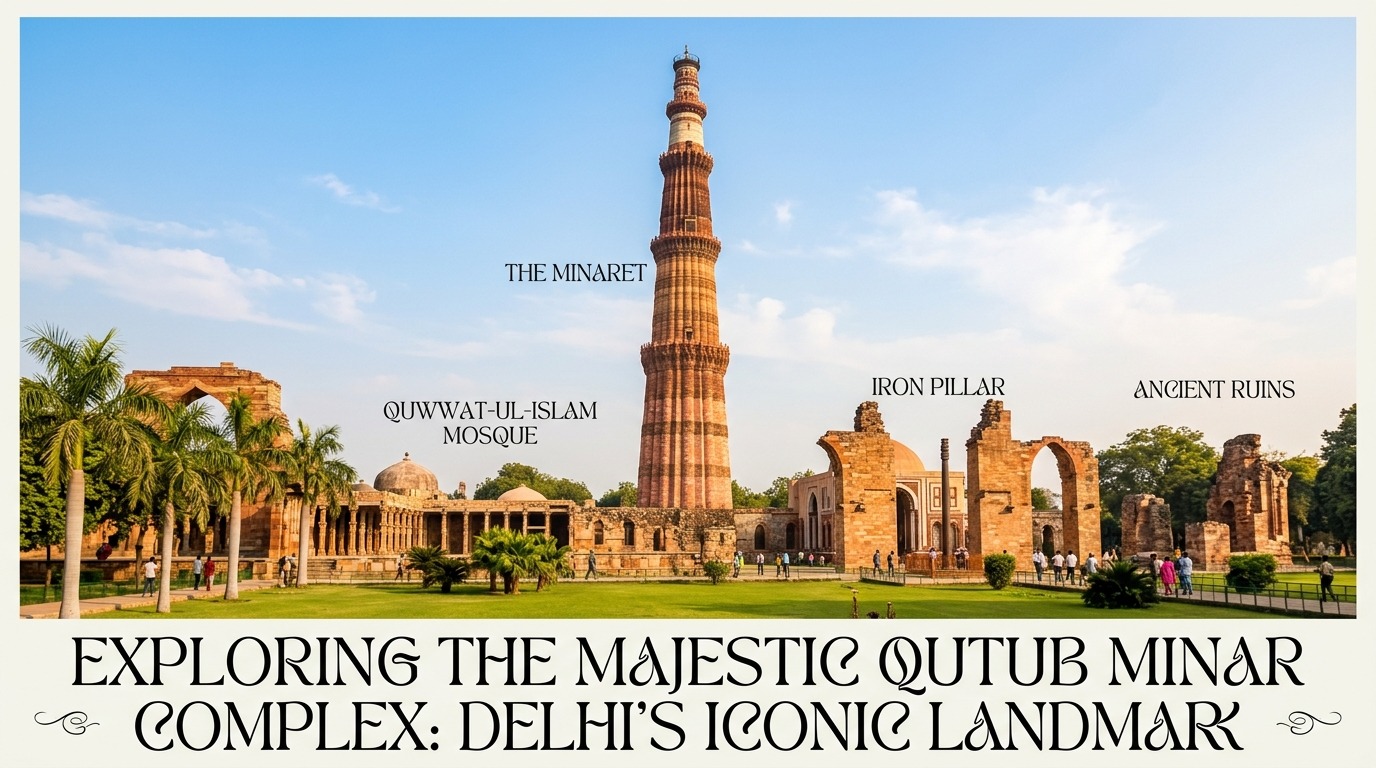
Qutub Minar is one of Delhi’s most recognisable historical landmarks, but the experience is about much more than standing in front of its famous red sandstone tower. Inside the Qutb complex, you can see centuries of architecture gathered in one place, including the Quwwatu’l-Islam Mosque, Alai Darwaza, the Iron Pillar, the Tomb of Iltutmish and the unfinished Alai Minar. Together, these monuments tell a much broader story of early medieval Delhi than the minaret alone.
Located in south Delhi, Qutub Minar is also a UNESCO World Heritage Site and remains one of the city’s essential heritage stops. The tower rises 72.5 metres and is decorated with alternating angular and rounded flutings, carved details and inscription bands. If you are planning a visit, giving yourself enough time to explore the entire archaeological complex rather than taking a quick photograph outside makes the trip far more rewarding.
Qutub Minar at a Glance
| Travel Detail | Information |
| Location | Mehrauli, South Delhi |
| Height | 72.5 metres |
| Heritage status | UNESCO World Heritage Site |
| Main material | Red and buff sandstone, with other materials used across the complex |
| Major attractions | Qutub Minar, Quwwatu’l-Islam Mosque, Iron Pillar, Alai Darwaza, Tomb of Iltutmish and Alai Minar |
| Best for | History, architecture, photography and heritage walks |
| Suggested visit duration | Around 1.5–3 hours |
| Nearest Metro | Qutub Minar Metro Station |
| Managed by | Archaeological Survey of India |
| UNESCO inscription | 1993 |
UNESCO describes the Qutb Minar and its surrounding monuments as an outstanding example of the architectural and artistic achievements of early Islamic India.
Why Qutub Minar Is Famous
Qutub Minar is famous primarily for its extraordinary height, age, architecture and historical setting.
The tower was built in the early 13th century and reaches 72.5 metres. Its shaft gradually narrows from approximately 14.32 metres at the base to 2.75 metres at the top. The exterior changes visually from one storey to another through different patterns of fluting, balconies and inscriptional decoration.
But the real attraction is the Qutb Minar complex, not just the tower.
Walking through the surrounding monuments gives visitors a chance to see how different rulers expanded and altered the site over several centuries. The result is an archaeological landscape where mosques, gateways, tombs, minars and carved architectural elements stand close together.
History of Qutub Minar

The history of Qutub Minar is closely connected with the establishment and expansion of early Islamic rule in northern India.
The tower was begun under Qutb ud-Din Aibak around the beginning of the 13th century and was subsequently continued by Shamsu’d-Din Iltutmish. Later rulers also carried out changes and repairs. UNESCO records the minar as part of a larger complex that developed over several generations rather than being the work of a single ruler at one moment in time.
This layered history is one reason the site is so valuable. Instead of presenting a single architectural style, the complex preserves evidence of changing political power, religious architecture and artistic traditions.
Why the Architecture Matters
The Qutub Minar combines a tall, tapering form with carved sandstone surfaces, projecting balconies and bands of inscriptions.
Its architectural language also reflects influences from the wider Islamic world while incorporating elements associated with the Indian architectural traditions of the period. UNESCO notes that the Quwwatu’l-Islam Mosque includes carved pillars and other elements associated with earlier Hindu and Jain temple traditions.
Qutub Minar Architecture: What to Look For
The tower is easiest to appreciate when you slow down and look at its details rather than viewing it only as a tall monument.
Notice the changing fluting patterns on the lower storeys, the carved bands running around the tower and the balconies separating its levels. The red and buff sandstone gives the monument a distinctive appearance, particularly when sunlight changes across its surface.
UNESCO identifies Qutub Minar as the tallest masonry tower in India and notes its combination of architectural form, inscriptions and decorative stonework.
The Five Storeys
The present tower consists of five storeys separated by projecting balconies.
The lower portions have different combinations of angular and rounded fluting, while the upper sections have their own decorative treatment. This variation becomes much easier to appreciate when viewed from several points within the complex.
Major Attractions Inside the Qutb Complex
A visit to Qutub Minar should include more than the tower itself.
Quwwatu’l-Islam Mosque
The Quwwatu’l-Islam Mosque is one of the most historically important structures within the complex. UNESCO describes it as the oldest surviving mosque in northern India and notes the incorporation of architectural material and carved elements from earlier temples.
Its surviving arches, pillars, screens and decorative details provide important context for understanding the early architectural history of the complex.
Iron Pillar
The Iron Pillar stands within the mosque courtyard and is one of the site’s most intriguing objects.
Its historical importance comes from its age, craftsmanship and inscription. UNESCO notes that the pillar is associated with a much earlier period than the surrounding medieval complex, giving the site another layer of history.
Alai Darwaza
Alai Darwaza is one of the architectural highlights of the complex.
Built under Alauddin Khilji in 1311, the gateway is particularly notable for its ornamentation and Indo-Islamic architectural design. UNESCO describes it as a masterpiece of Indo-Muslim art.
Tomb of Iltutmish
The Tomb of Iltutmish is another important structure within the complex.
Its interior decoration includes carved inscriptions, geometric designs and arabesque patterns. It is significant not only as a royal tomb but also in the development of the architectural tradition of royal funerary buildings in India.
Alai Minar
The unfinished Alai Minar is an interesting contrast to Qutub Minar.
Alauddin Khilji intended the tower to be much larger than Qutub Minar. Only its first storey was completed, and UNESCO records that the surviving portion stands about 25 metres high.
Seeing the two towers within the same complex makes it easier to understand the scale of the original ambition.
Best Time to Visit Qutub Minar
The most comfortable time to explore Qutub Minar is generally during Delhi’s cooler months, especially from October to March.
Winter mornings and late afternoons are usually more pleasant for walking around the open archaeological complex. The softer light can also make the sandstone architecture particularly attractive for photography.
Summer afternoons can be hot, so visitors travelling between April and June should consider an earlier visit and carry water. During the monsoon, occasional rain can make outdoor walking less predictable, although the complex remains an important Delhi heritage attraction.
| Season | What to Expect | Best Approach |
| October–March | Cooler weather and comfortable sightseeing | Ideal for a detailed visit |
| April–June | Hot afternoons | Visit earlier in the day |
| July–September | Monsoon conditions and occasional rain | Carry rain protection and allow flexibility |
| Early morning | Quieter and cooler | Good for photography and relaxed exploration |
| Late afternoon | Softer light and cooler temperatures | Good for architecture photography |
Always check the latest official visitor information before travelling because opening arrangements and entry procedures can change.
Qutub Minar Timings and Tickets

Qutub Minar is an Archaeological Survey of India-managed heritage site, and ticketing is handled through the official monument-booking system. The ASI’s online ticket portal provides the current booking interface.
Because entry fees and visitor arrangements can change, it is better to check the official ASI booking system shortly before your visit instead of relying on an old travel blog or outdated social media post.
Delhi Tourism also includes Qutub Minar in its sightseeing programmes, reflecting its established place among the city’s major heritage attractions.
How to Reach Qutub Minar
Qutub Minar is in Mehrauli in South Delhi and is well connected to the wider city.
By Metro
The Delhi Metro is one of the most convenient ways to travel toward Qutub Minar. The Qutub Minar Metro Station is on the Yellow Line, after which visitors can continue the remaining distance by local transport or an auto-rickshaw.
If you are travelling during a busy period, using the Metro can be easier than relying entirely on road traffic.
By Taxi or Auto-Rickshaw
App-based cabs, taxis and auto-rickshaws can take you directly toward the monument.
Travel time depends heavily on where you start in Delhi and the traffic at the time of day, so it is better to plan with a time buffer rather than relying on a fixed journey estimate.
By Delhi Tourism Sightseeing Bus
Delhi Tourism also includes Qutub Minar in its organised city sightseeing tours. Current tour schedules and prices should be checked directly with Delhi Tourism before making plans.
How Much Time Do You Need at Qutub Minar?
For a quick look at the main monuments, around 1.5 hours may be enough.
However, two to three hours is a better choice if you want to explore the archaeological complex at a relaxed pace, read the information panels, photograph the architecture and spend time at the major monuments.
If you are particularly interested in history or architecture, allow extra time rather than trying to combine Qutub Minar with too many other Delhi attractions in the same short window.
Photography Tips for Qutub Minar

Qutub Minar is one of Delhi’s strongest architectural photography locations because the tower looks different from different angles.
For a full-height composition, step farther back and use the surrounding open spaces rather than trying to photograph the monument from directly underneath. Details such as carved stone, balconies, inscriptions and arches are also worth photographing separately.
Morning and late afternoon can provide softer natural light than the harshest part of the day.
Remember that the site is a protected heritage property, so photography should not interfere with other visitors or conservation rules.
Places to Visit Near Qutub Minar
Qutub Minar can easily be combined with other heritage and cultural attractions in South Delhi.
Mehrauli Archaeological Park
The wider Mehrauli area contains an important collection of historic remains and archaeological landscapes. UNESCO notes the presence of Mehrauli Archaeological Park in the peripheral area surrounding the World Heritage property.
Garden of Five Senses
The Garden of Five Senses is another nearby attraction that can work well as a more relaxed stop after a heritage visit.
Lotus Temple
Lotus Temple is farther away but can be combined with Qutub Minar as part of a South Delhi sightseeing day, depending on traffic and how much time you have.
Qutub Minar Visit Plan
If you want to make the most of your visit, a simple half-day plan works well.
| Time | Suggested Plan |
| Morning | Arrive at Qutub Minar and explore the main tower |
| Late morning | Visit Quwwatu’l-Islam Mosque, Iron Pillar and Tomb of Iltutmish |
| Midday | See Alai Darwaza and Alai Minar |
| Later | Continue to another South Delhi attraction or take a break |
| Afternoon option | Explore nearby heritage areas if weather is comfortable |
The exact order can be adjusted according to opening arrangements, weather and crowd levels.
What to Know Before Visiting Qutub Minar
A little preparation can make the visit much easier.
Wear comfortable footwear because the complex involves considerable walking over an outdoor archaeological site. Carry water, particularly during warmer months, and consider sun protection when visiting during the day.
It is also worth remembering that Qutub Minar is a protected heritage site, not simply a photo location. Follow visitor instructions, avoid touching or climbing historic structures and respect restricted areas.
Most importantly, give yourself time to look beyond the main tower. The surrounding monuments are what turn a short stop into a meaningful heritage visit.
Why Qutub Minar Belongs on a Delhi Itinerary
Qutub Minar brings together architecture, history and archaeology in a way few individual landmarks can.
Its 72.5-metre tower naturally attracts attention, but the surrounding complex adds the depth. The mosque, Iron Pillar, tombs, gateways and unfinished Alai Minar show how the site developed through different periods and rulers. UNESCO inscribed Qutb Minar and its Monuments on the World Heritage List in 1993 because of the site’s outstanding architectural and artistic significance.
For travellers interested in Delhi’s history, architecture or photography, it is worth treating Qutub Minar as a complete heritage experience rather than a quick sightseeing stop.
FAQs
What is Qutub Minar famous for?
Qutub Minar is famous for its 72.5-metre red sandstone tower, early medieval history, detailed architecture and the collection of historic monuments surrounding it. The entire Qutb Minar complex is a UNESCO World Heritage Site.
How tall is Qutub Minar?
Qutub Minar is 72.5 metres tall. UNESCO records its diameter as approximately 14.32 metres at the base and 2.75 metres at the top.
What can I see inside the Qutub Minar complex?
Visitors can see the Qutub Minar, Quwwatu’l-Islam Mosque, Iron Pillar, Alai Darwaza, Tomb of Iltutmish and the unfinished Alai Minar, along with other archaeological remains.
What is the best time to visit Qutub Minar?
October to March is generally the most comfortable period for exploring the outdoor complex because Delhi’s weather is cooler. Early mornings and late afternoons are also useful choices if you want more comfortable walking and softer light for photography.
How do I reach Qutub Minar?
Qutub Minar is in Mehrauli, South Delhi. The Delhi Metro is a convenient option, with Qutub Minar Metro Station providing access to the monument area. Taxis and auto-rickshaws are also widely used for the final part of the journey.
Conclusion
Qutub Minar is much more than a towering red sandstone landmark. Its real appeal lies in the wider archaeological complex, where the minar stands alongside the Quwwatu’l-Islam Mosque, Iron Pillar, Alai Darwaza, royal tombs and the unfinished Alai Minar. Together, these monuments reveal layers of Delhi’s architectural and political history that cannot be understood from the tower alone.
If you are planning a Delhi sightseeing trip, set aside at least a couple of hours for Qutub Minar, visit during the more comfortable parts of the day and take time to notice the smaller architectural details. A slower visit makes it easier to appreciate why this historic complex remains one of Delhi’s most important heritage destinations.
Read More; Ayodhya Temple Travel Guide: Ram Mandir History, Darshan, Timings & Travel Tips

I am a travel enthusiast who loves exploring India’s beautiful destinations, culture, history, food, and hidden places. Through my travel website, I aim to help travelers discover amazing places in India and plan memorable trips with useful travel information and tips.