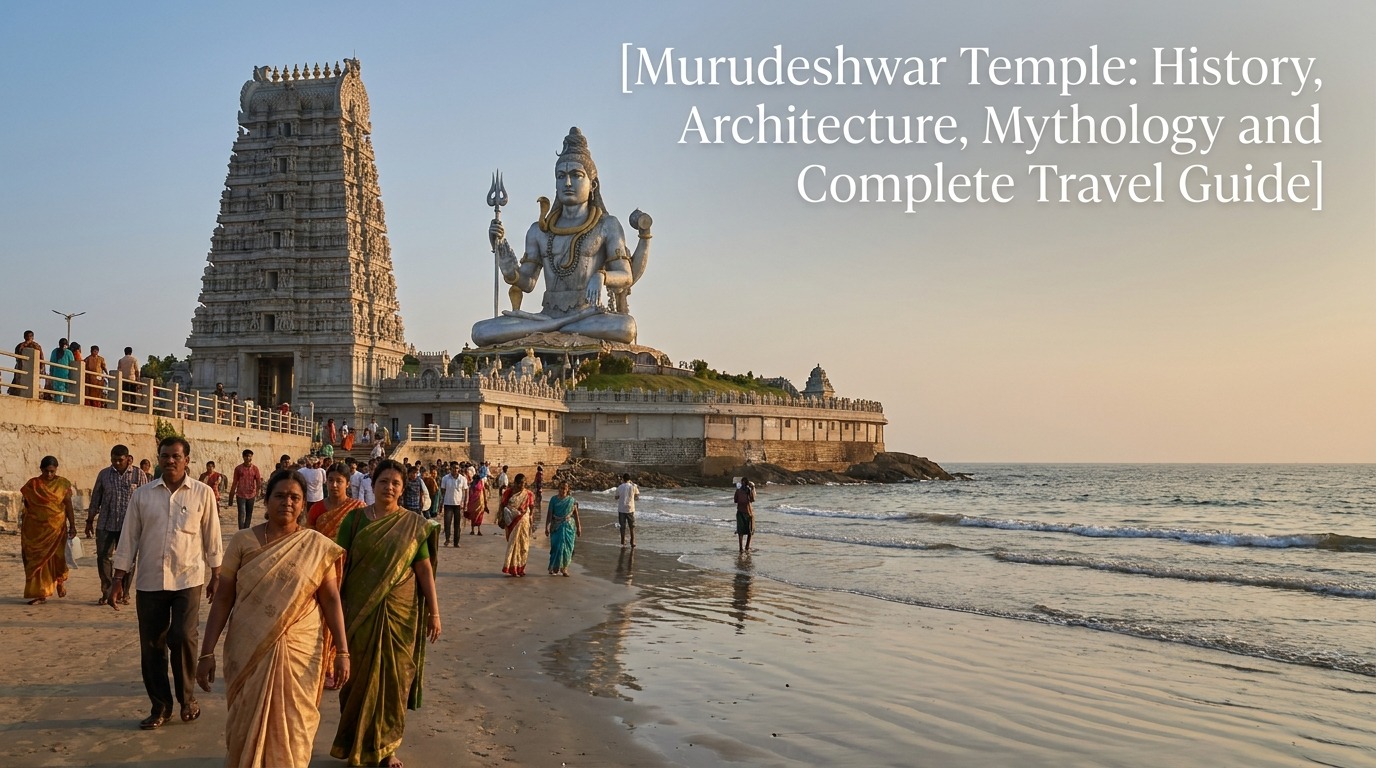
Murudeshwar Temple stands dramatically on the Karnataka coast, where the Arabian Sea surrounds Kanduka Hill on three sides and one of India’s most recognisable images of Lord Shiva rises above the shoreline. The temple is famous not only for its religious importance but also for its striking setting, enormous Shiva statue, towering Raja Gopuram and the unusual way sacred architecture, mythology and coastal scenery come together in one compact destination. For pilgrims, the attraction is deeply connected with Shiva and the traditional story of the Atma Linga; for travellers, the same visit can include sea views, old temple traditions, a historic coastal landscape and nearby destinations such as Gokarna and Mirjan Fort.
A visit to Murudeshwar Temple is therefore more than a quick stop for darshan. The present landscape reflects several layers of history and later development, while the sacred identity of the place reaches much further back through Hindu tradition. The temple complex seen today combines an older shrine with striking modern additions, including the 123-foot Shiva statue and the 20-storey Raja Gopuram. Understanding that contrast makes the destination especially interesting: ancient mythology explains why the site is sacred, regional history explains its continuing importance, and modern construction has transformed it into one of coastal Karnataka’s most memorable landmarks.
Murudeshwar Temple Location and Setting
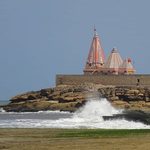
Murudeshwar is a coastal town in Bhatkal Taluk of Uttara Kannada district, Karnataka, on India’s Arabian Sea coast. The temple occupies Kanduka Hill, giving the complex an unusually open setting. Instead of being enclosed by a dense urban landscape, the shrine looks towards the sea, while the monumental Shiva statue dominates the skyline from the hill.
The setting is one of the temple’s defining characteristics. The sea is visible around much of the hill, and the contrast between the blue horizon, the temple structures and the pale stone-and-white exterior of the newer architecture gives the site a distinctive visual identity.
The town itself is also closely tied to the temple. Murudeshwar is not simply a beach destination with a temple nearby; religious tourism is central to its character. Pilgrims, families, photographers and coastal travellers all arrive for somewhat different reasons, yet the temple remains the visual and cultural centre of the town.
The district administration describes Murudeshwar as a religious destination famous for its 123-foot Shiva statue and its coastal position. The same official source places the town about 18 kilometres from Bhatkal and identifies Mangaluru as the nearest airport gateway.
| Location Detail | Information |
| Town | Murudeshwar |
| Taluk | Bhatkal |
| District | Uttara Kannada |
| State | Karnataka |
| Coast | Arabian Sea |
| Main landmark | Murudeshwar Temple and Shiva statue |
| Hill | Kanduka Hill |
| Nearest major airport | Mangaluru International Airport |
The hilltop location also changes how the temple feels during different parts of the day. Morning light gives the complex a calm appearance, while late afternoon brings stronger contrasts between the structures and the sea. From elevated points around the complex, the coastline becomes an important part of the experience rather than merely a backdrop.
Murudeshwar Temple Mythology and the Atma Linga
The religious identity of Murudeshwar Temple is closely connected with the traditional story of Ravana and the Atma Linga. This is a mythological account rather than a historically documented event, and it should be understood within the wider Hindu sacred tradition associated with Shiva.
According to the traditional story, Ravana, the powerful king of Lanka described in the Ramayana tradition, undertook severe penance to please Lord Shiva. Shiva eventually granted him the Atma Linga, a sacred object associated with extraordinary spiritual power.
Ravana intended to take the Atma Linga to Lanka. The gods, however, feared the consequences if such power came into his possession. According to the legend, Lord Ganesha intervened by appearing in disguise and causing Ravana to place the linga on the ground. Once placed there, it could no longer be moved.
The story continues with Ravana attempting to pull the sacred linga away. In the traditional account, pieces associated with it were scattered across different places along the Karnataka coast. Gokarna, Murudeshwar and other sacred sites are connected with different parts of this narrative in regional religious tradition.
This mythology helps explain why the coastal belt of Karnataka contains several important Shiva pilgrimage centres associated with the Atma Linga story. It also gives Murudeshwar a religious identity that extends beyond the physical temple building.
The modern visitor should distinguish between this sacred narrative and documented architectural history. The legend belongs to religious tradition, while the surviving built structures have developed through different historical periods and later renovations. Karnataka Tourism itself presents Murudeshwar through both its Ramayana-linked mythology and its modern architectural landmarks.
Murudeshwar Temple History Through the Centuries
The precise early history of the shrine is difficult to establish from securely dated evidence. Claims sometimes made online about extremely ancient construction dates should therefore be treated cautiously. What can be said more confidently is that the sacred importance of the site is rooted in longstanding Hindu tradition, while the architectural history visible today includes influences from later periods.
The wider coastal Karnataka region became an important zone of interaction between several political powers and cultural traditions. The Vijayanagara Empire exercised major influence over Karnataka from the 14th century onward, while the later Keladi Nayakas became particularly important in the coastal and Malnad regions.
The Keladi Nayakas emerged from the political world of Vijayanagara and eventually established their own power in Karnataka. Their period, broadly spanning the 16th to 18th centuries, was significant for temple construction and patronage across the region. Their architectural traditions combined elements associated with Vijayanagara, Dravidian and Hoysala-derived forms.
However, it is important not to assign every surviving element at Murudeshwar automatically to one dynasty. Unlike some better-documented monuments, the temple does not offer a simple, universally accepted construction date for the entire complex. Later additions and modern reconstruction have substantially changed the appearance of the site.
The distinction between the sacred core and the monumental additions visible today is particularly important. The temple’s modern appearance cannot be used as evidence that the entire structure was built recently, just as its ancient religious mythology cannot by itself establish a precise archaeological date.
During the 20th and early 21st centuries, the complex underwent major development. Contemporary accounts associate extensive modernisation with businessman and philanthropist R. N. Shetty. The enormous Shiva statue was erected in 2006, while the present Raja Gopuram was completed in 2008.
This created the extraordinary visual combination visitors see today: an old sacred centre surrounded by monumental modern architecture. It is one reason Murudeshwar feels different from many historic temple towns in southern India.
A Note on Historical Claims
Some sources claim that the temple has origins stretching back thousands of years or even to the 6th century BCE. Such claims are not sufficiently supported by the strongest official sources available for the site. A responsible travel account should therefore distinguish between the antiquity of the religious tradition and the securely documented history of the existing structures.
The safer historical conclusion is that Murudeshwar is an old sacred centre whose present temple landscape has evolved over time, with regional Nayaka-era influences followed by significant modern development.
Murudeshwar Temple Architecture and Design
The architecture of Murudeshwar Temple is best understood as a meeting point between traditional Hindu temple design and large-scale modern construction.
The Raja Gopuram immediately attracts attention. Karnataka Tourism describes it as a 20-storey tower rising approximately 249 feet. Its scale is striking even before a visitor reaches the temple complex, and its vertical form creates a dramatic counterpoint to the broad horizontal expanse of the Arabian Sea.
The gopuram is more than an entrance structure. Its upper levels provide an elevated viewpoint over the temple, coastline and surrounding town. A lift allows visitors to reach the top, making the tower both a religious architectural feature and a modern viewing point.
The visual language of the complex is different from the weathered stone appearance associated with many medieval temples. Much of what visitors see has been renovated, enlarged or constructed in relatively recent times. This is particularly noticeable around the monumental Shiva statue and Raja Gopuram.
The temple’s setting also contributes to the architecture. On a crowded urban street, the same structures would feel very different. At Murudeshwar, the open sea and hilltop location give the tower and statue a powerful sense of scale.
The complex demonstrates how sacred architecture can continue evolving without losing the religious significance of its central shrine. For visitors interested in architectural history, the most useful approach is to look for the contrast between older temple traditions and newer monumental elements rather than treating the entire complex as belonging to one architectural period.
Murudeshwar Temple Shiva Statue and Raja Gopuram
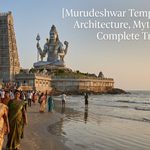
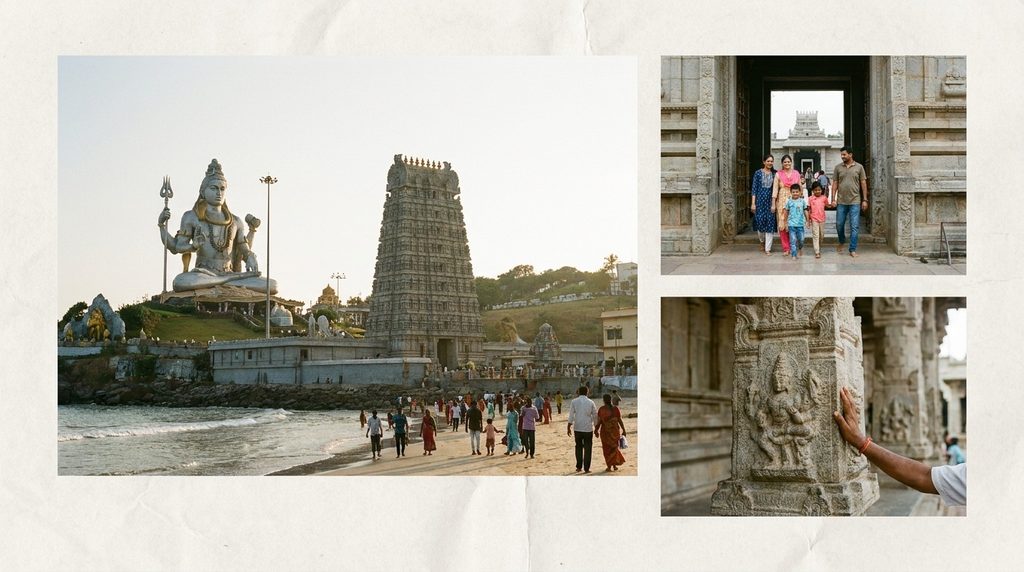
The 123-foot Shiva statue is the landmark most closely associated with modern Murudeshwar. It sits on Kanduka Hill and is visible from various points around the town and coast. The Uttara Kannada district administration identifies it as one of the world’s tallest Shiva statues and states that its construction took approximately two years.
The statue is designed in a seated form and faces towards the Arabian Sea. Its elevated position makes it appear even larger because there are few nearby structures that compete with its scale.
The statue should not be confused with the temple’s central deity or sacred linga. It is a monumental representation of Shiva and a major visual symbol of the town, while the temple itself remains the principal place of worship.
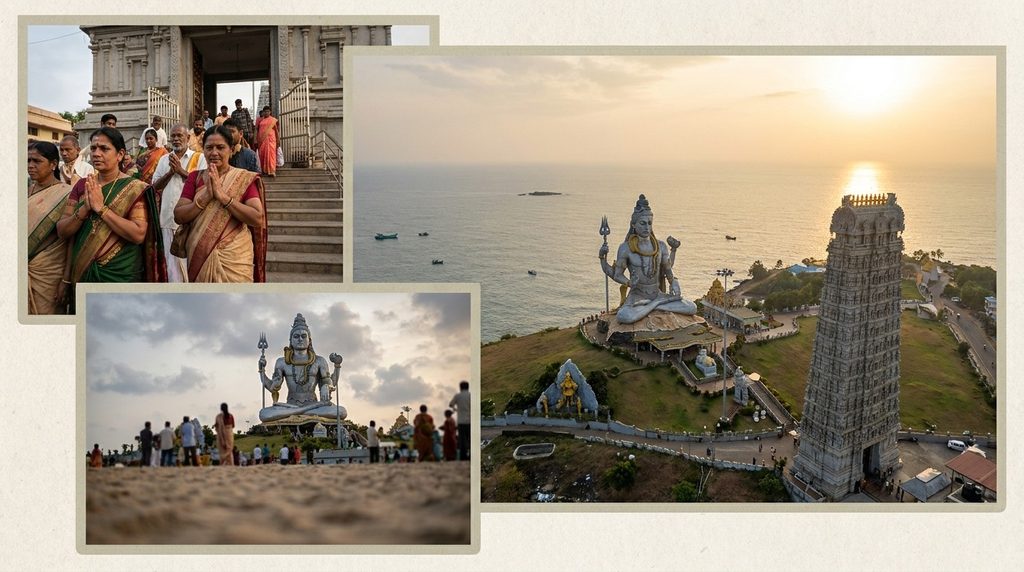
The Raja Gopuram creates another major visual focal point. At approximately 249 feet, the tower rises roughly 20 storeys and contains a lift for visitors. From above, the relationship between the hill, temple complex and sea becomes particularly clear.
For photography, the statue and gopuram offer very different perspectives. From farther away, the statue appears framed by the coastline. From within the complex, the viewer experiences its scale more directly. At the upper level of the gopuram, the composition changes again, with the temple grounds below and the Arabian Sea extending into the distance.
| Major Landmark | Approximate Height / Scale | Why It Matters |
| Shiva statue | 123 feet | Major modern symbol of Murudeshwar |
| Raja Gopuram | 249 feet | Monumental temple tower and viewpoint |
| Kanduka Hill | Hilltop setting | Places the temple above the coastline |
| Temple complex | Coastal sacred precinct | Religious and cultural heart of the town |
Murudeshwar Temple Religious Importance and Traditions
For devotees, Murudeshwar is primarily a place of Shiva worship rather than simply an architectural attraction. The religious importance of the site is rooted in the Atma Linga tradition and in the long-standing association of the Karnataka coast with Shiva pilgrimage.
Temple visits traditionally involve darshan, prayer and devotional observances. The experience is different from visiting a monument where the architecture is the main focus. Visitors should remember that the temple is an active place of worship, so the rhythm of the day is influenced by religious practice rather than tourism alone.
Festivals and auspicious Hindu occasions can bring larger numbers of devotees. Maha Shivaratri is particularly important because it is dedicated to Lord Shiva, and Murudeshwar becomes especially devotional around major religious observances.
Shravan, the Hindu month associated strongly with Shiva worship, can also be an important period for devotees. Crowd levels during religious festivals can be considerably different from those during an ordinary weekday.
A respectful visitor does not need to be a pilgrim to appreciate the atmosphere. Observing quietly, dressing appropriately for a temple setting, following photography restrictions and avoiding disruption during prayers are simple ways to respect the place.
It is also worth remembering that the enormous Shiva statue and coastal scenery can make the destination feel like a conventional tourist attraction. The temple itself, however, remains a functioning religious centre. That distinction should guide behaviour throughout the visit.
Murudeshwar Temple Best Time to Visit
The best time to visit depends on whether the main priority is temple sightseeing, comfortable coastal weather or nearby outdoor experiences.
For most travellers, October through February offers the most comfortable overall conditions. Karnataka Tourism describes this period as the main season, with clearer skies and more favourable coastal conditions.
The post-monsoon months can be particularly attractive because the surrounding landscape remains green while the weather becomes more suitable for sightseeing. December and January are popular with travellers, so accommodation can become busier during holiday periods.
March to May is warmer and more humid. The temple remains accessible, but daytime sightseeing can feel less comfortable, particularly around exposed sections of the hill and beach.
The monsoon, generally from June into September, brings heavy rainfall to coastal Karnataka. The landscape becomes lush and atmospheric, but sea conditions can become unsuitable for many coastal activities. Travellers visiting during this period should keep their plans flexible and check local conditions.
For purely religious travel, weather does not necessarily determine the value of the visit. A quieter rainy-season temple can have a very different atmosphere from the busier winter period.
| Season | General Conditions | Best For | Planning Note |
| October–November | Post-monsoon, greener landscape | Temple, sightseeing, coastal travel | Good overall period |
| December–February | Generally comfortable | Temple and sightseeing | Busier around holidays |
| March–May | Hotter and more humid | Short temple visits | Plan outdoor sightseeing around cooler hours |
| June–September | Rainy monsoon | Quiet temple visits, lush scenery | Sea conditions can restrict outdoor activities |
If your trip includes Netrani Island or other sea-based activities, the weather matters even more. Karnataka Tourism recommends avoiding the monsoon for Netrani diving because sea and visibility conditions are less favourable.
Murudeshwar Temple Darshan and Visitor Experience
A temple visit is usually best approached without rushing. Even if you have only a few hours in Murudeshwar, allow time to understand the complex rather than treating it as a photograph-and-leave stop.
Start with the temple itself and observe the movement of devotees. The central religious spaces deserve more attention than the exterior attractions because they explain why the destination exists in the first place.
After darshan, explore the surrounding complex at a relaxed pace. The Shiva statue provides a completely different experience from the sanctum. The statue represents monumental modern devotion, while the shrine represents the older religious continuity of the place.
The Raja Gopuram is another natural part of the visit. The elevated viewpoint allows you to understand the temple’s geographical setting, particularly the relationship between Kanduka Hill and the Arabian Sea.
Temple etiquette is important. Clothing should be respectful, footwear rules should be followed, and visitors should comply with any restrictions on photography or entry. During busy festival periods, follow the directions of temple staff rather than trying to find alternative ways through crowded areas.
If you are travelling with children or older family members, allow extra time for walking and waiting. The combination of hilltop spaces, temple crowds and coastal heat can make an apparently short visit feel longer than expected.
Murudeshwar Temple Beach and Coastal Landscape
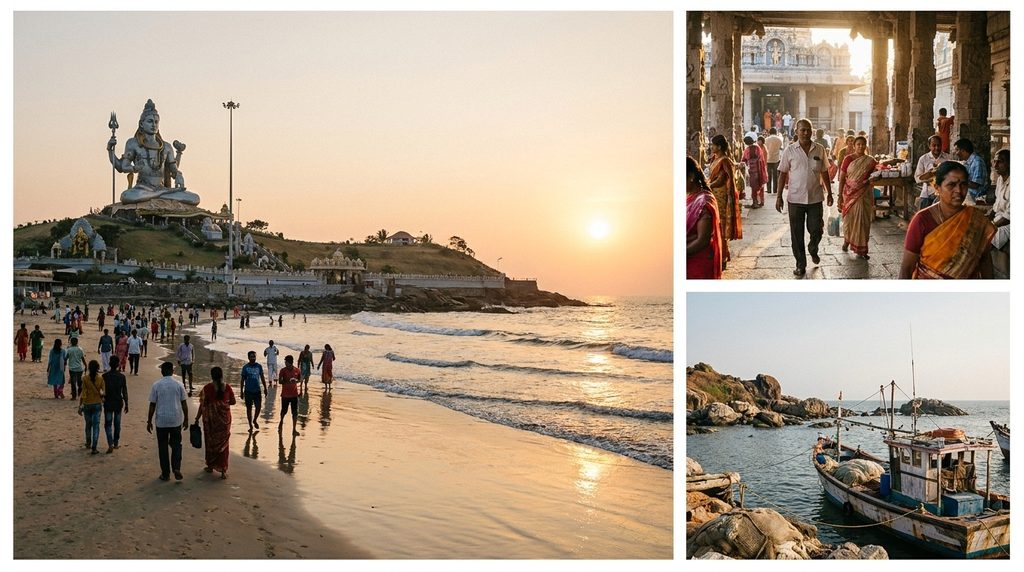
Murudeshwar Beach is one of the reasons the destination feels different from an inland pilgrimage centre. The shoreline sits immediately beside a major religious complex, creating an unusual transition from temple architecture to open sea.
The beach is useful for experiencing the landscape around the temple rather than simply as a separate attraction. Looking back towards Kanduka Hill from the coast gives one of the clearest perspectives of the Shiva statue and temple skyline.
The coastal environment changes throughout the day. Early morning tends to feel quieter, while the late afternoon brings softer light and stronger visual contrast. Sunset can be especially attractive because the statue and temple structures become silhouettes against the changing sky.
Visitors should remember that the Arabian Sea can be unpredictable, particularly during monsoon weather. Swimming or entering the water should only be considered where local conditions and safety arrangements permit it.
Karnataka Tourism also lists recreational coastal activities around Murudeshwar, but availability can change with weather and local operating conditions.
For travellers mainly interested in the temple, there is no need to turn the visit into an activity-heavy beach day. Simply spending some time along the shore can add valuable context to the destination.
Murudeshwar Temple Netrani Island and Marine Landscape
Netrani Island is one of the best-known attractions associated with Murudeshwar. The island lies offshore and is widely known for marine biodiversity and underwater experiences.
Karnataka Tourism describes Netrani as a significant diving destination with coral habitats and a variety of marine life. The island itself is uninhabited and has restrictions on public landing, while boat-based access to the surrounding waters is organised through operators.
This makes Netrani different from an ordinary island day trip. Travellers should not assume that they can simply land on the island or explore it independently.
Sea conditions are also important. Boat journeys can vary with weather, and the monsoon is generally unsuitable for the kind of marine excursions for which the area is known.
For younger visitors especially, any water-based activity should be undertaken only through legitimate, properly supervised operators and according to local safety requirements. A temple-focused trip does not require participation in such activities, and the coastline can be appreciated perfectly well from land.
The wider marine environment is nevertheless an important part of Murudeshwar’s identity. It explains why the town attracts both pilgrims and travellers interested in Karnataka’s coastal landscape.
Murudeshwar Temple Nearby Attractions and Day Trips
Murudeshwar works particularly well as part of a larger coastal Karnataka itinerary. Several important destinations can be reached by road, although travel times depend on traffic, road conditions and the exact starting point.
Gokarna is one of the most natural additions. Karnataka Tourism places Gokarna about 78 kilometres from Murudeshwar by road in its current destination information, while other tourism material uses slightly different approximate distances depending on the route.
Gokarna offers a very different atmosphere. Its Mahabaleshwar Temple and traditional pilgrimage identity provide another major Shiva destination, while beaches such as Om Beach and Kudle Beach give the trip a broader coastal character.
Mirjan Fort is another worthwhile stop. Karnataka Tourism describes the fort as a 16th-century structure associated with the Bijapur Sultanate, situated near the Aghanashini River. Its surviving walls and bastions make it particularly interesting for travellers who want to add regional history to a temple-and-beach itinerary.
Idagunji is important for pilgrims interested in coastal Karnataka’s temple traditions. The Mahaganapathi Temple there offers another opportunity to explore the region’s religious landscape.
Yana Caves provide a completely different experience, with dramatic rock formations surrounded by forest. They are useful for travellers planning a longer road itinerary rather than a short Murudeshwar weekend.
Jog Falls can also be included when time permits. The waterfall is considerably farther away than Gokarna or Mirjan Fort, so it is better treated as part of a broader North Karnataka or Western Ghats itinerary.
| Nearby Destination | Approximate Relationship to Murudeshwar | Main Interest |
| Gokarna | About 78 km by road | Shiva pilgrimage, beaches |
| Mirjan Fort | About 18 km | Historic fort and architecture |
| Idagunji | About 35 km | Ganapathi temple |
| Yana Caves | About 60 km | Forest and rock formations |
| Jog Falls | About 120 km | Major waterfall |
Distances are approximate and can vary according to the route used. Karnataka Tourism’s current Murudeshwara destination page provides these figures as planning references.
Murudeshwar Temple How to Reach by Road
Road travel is one of the most convenient ways to include Murudeshwar in a Karnataka coastal itinerary. National Highway 66 runs along the western coast and provides an important road connection for travellers moving between towns in coastal Karnataka.
The road journey can itself be part of the experience. Coconut palms, small settlements, waterways and stretches of coastline appear along different sections of the route, although the exact scenery depends on the direction of travel.
Current Karnataka Tourism information gives approximate road distances of around 500 kilometres from Bengaluru, 165 kilometres from Mangaluru and 230 kilometres from Panaji.
Because road conditions and travel times can change, these figures should be treated as planning estimates rather than guarantees.
For a family trip, a private car can make it easier to combine Murudeshwar with Gokarna, Mirjan Fort or other destinations. Buses are also available on routes serving coastal Karnataka.
The town is relatively compact around the temple area, making the final portion of the journey straightforward once you arrive in Murudeshwar.
Murudeshwar Temple Train and Air Connectivity
Murudeshwar has its own railway station on the Konkan Railway network. Rail travel is particularly useful for visitors travelling along the west coast because the railway line connects several important destinations between Maharashtra, Goa and Karnataka.
Train schedules and stopping patterns vary, so checking the current timetable before booking is essential.
For air travellers, Mangaluru International Airport is the principal airport gateway. Current Karnataka Tourism information places it at approximately 165 kilometres from Murudeshwar, while other official tourism material gives figures around 150–157 kilometres depending on the reference point used.
The airport option is most practical when Murudeshwar is part of a wider coastal Karnataka trip. From the airport, travellers can continue by road.
| Travel Mode | Main Option | Planning Consideration |
| Train | Murudeshwar Railway Station | Check current stopping trains |
| Air | Mangaluru International Airport | Continue by road |
| Road | NH66 and regional roads | Useful for multi-stop itineraries |
| Bus | Coastal Karnataka services | Check current schedules |
The Uttara Kannada district administration also identifies Bhatkal as a nearby railway point and places Murudeshwar about 18 kilometres from Bhatkal.

Murudeshwar Temple Where to Stay and How Long to Plan
Murudeshwar has accommodation ranging from budget and mid-range properties to more comfortable stays. The most convenient choice depends on whether the trip is centred on temple visits or is part of a longer coastal journey.
For a simple temple-focused visit, one night is generally enough to see the main complex, Shiva statue, gopuram viewpoint and nearby beach at a relaxed pace.
Two nights make more sense if you want to include additional nearby attractions or build in flexibility around weather.
Travellers planning a broader coastal route may prefer to stay in Murudeshwar rather than returning to another town after the temple visit. Staying locally also makes it easier to experience the area during quieter morning or evening hours.
During major Hindu festivals and holiday periods, accommodation demand can increase. Advance planning is sensible during such dates, particularly if your schedule is fixed.
The most important factor is location rather than luxury. A property with convenient access to the temple area can save considerable travel time and make an early visit easier.
Murudeshwar Temple Food, Culture and Local Atmosphere
A temple town is best understood through more than monuments. Murudeshwar’s local character comes from the meeting of pilgrimage, coastal life and Karnataka’s food traditions.
Visitors will find South Indian staples alongside the broader cuisine of coastal Karnataka. Vegetarian food is especially easy to find around major pilgrimage areas, while local restaurants may offer a wider selection reflecting the coastal region.
The town’s atmosphere also changes with the flow of pilgrims. On an ordinary day, the surroundings can feel relatively relaxed; during major religious occasions, the streets and temple approaches may become much busier.
The coastal setting adds another layer. Fishing communities, seafood traditions and maritime life form part of the broader culture of the region, even though the temple precinct itself is primarily devotional.
Travellers should approach local customs with the same respect expected at any active religious site. Ask before photographing people, follow temple instructions and avoid treating worshippers as subjects for staged travel photography.
The most rewarding cultural experience is often simply paying attention: the sound of bells and prayers, the movement of pilgrims, the architecture of the complex and the changing light over the sea all contribute to the sense of place.
Murudeshwar Temple Photography and Best Viewpoints
Murudeshwar is one of those destinations where photographs can easily focus too much on the obvious landmark. The Shiva statue is spectacular, but the wider setting provides better storytelling opportunities.
From the beach, the statue can be framed against the sky and hill. From within the complex, its scale becomes more dramatic. From the Raja Gopuram viewpoint, the statue becomes part of a larger landscape that includes the temple, town and Arabian Sea.
Early morning is useful for softer light and fewer distractions. Late afternoon can create strong shadows and warm tones, while evening illumination changes the appearance of the statue and temple structures.
Photography inside active worship areas should always follow local rules. Some parts of a temple may restrict photography entirely, and visitors should not use cameras or phones in ways that disturb prayers.
A thoughtful travel photograph does not need to show every attraction at once. A close architectural detail, a wide coastal frame or a distant view of the Shiva statue can communicate the character of Murudeshwar more effectively than a crowded snapshot.
Murudeshwar Temple Practical Tips for First-Time Visitors
A little preparation can make the visit considerably smoother.
Wear comfortable, respectful clothing suitable for a Hindu temple. Carry footwear that is easy to remove because temple areas may require visitors to leave shoes outside designated spaces.
Start early if you want a quieter experience. Morning is also generally more comfortable for walking around exposed outdoor areas than the hotter part of the day.
Keep some flexibility in your itinerary. Coastal Karnataka weather can change quickly, especially during the monsoon, and sea-related plans are particularly weather-dependent.
If you are visiting during a major festival, expect larger crowds and allow substantially more time than you would on an ordinary day.
Do not rely on old online information for exact temple schedules, transport services or activity availability. Timings and operating arrangements can change, so confirm important details close to your travel date.
For the beach and surrounding coastal areas, follow local safety instructions. Conditions in the Arabian Sea can change rapidly, and activities may be restricted during rough weather.
Finally, remember that the temple is a place of worship first. The enormous statue, gopuram and beach are important attractions, but they exist alongside an active religious tradition. A respectful visit makes the destination more meaningful.
Murudeshwar Temple Suggested One-Day Itinerary
A well-planned one-day visit can cover the major highlights without making the schedule feel rushed.
Begin with the temple complex and allow enough time for darshan and quiet exploration. Once you have finished the religious portion of the visit, walk through the surrounding complex and take in the scale of the Shiva statue.
Next, visit the Raja Gopuram viewpoint if it is open and operating. The elevated perspective provides a useful understanding of the temple’s unusual hilltop setting.
Around midday, take a break for lunch and avoid packing too many outdoor activities into the hottest hours.
Later in the afternoon, spend time around the beach and coastline. This is when the relationship between the sea, hill and temple becomes particularly visible.
If conditions are suitable, the evening can be reserved for photography and a slower look at the illuminated temple landscape.
For travellers with additional time, the itinerary can be extended with Mirjan Fort or a separate visit to Gokarna on another day rather than trying to fit every destination into one schedule.
The best itinerary is not necessarily the one with the largest number of stops. Murudeshwar rewards travellers who give themselves time to understand its religious setting and enjoy its coastline.
FAQs
Why is Murudeshwar Temple famous?
Murudeshwar Temple is famous for its connection with Lord Shiva and the traditional Atma Linga story, as well as its dramatic Arabian Sea setting. The complex is also known for its 123-foot Shiva statue and approximately 249-foot Raja Gopuram.
Is Murudeshwar Temple a Jyotirlinga?
No. Murudeshwar is not traditionally counted among the twelve Jyotirlingas of Lord Shiva. Its religious importance comes from its own Shiva tradition and its association with the Atma Linga story.
What is the best time to visit Murudeshwar?
October to February is generally the most comfortable period for sightseeing because the monsoon has passed and coastal conditions are more favourable. If your plans include marine activities, weather and sea conditions should be checked separately.
How can visitors reach Murudeshwar?
Murudeshwar can be reached by road and train, while Mangaluru International Airport is the main nearby airport gateway. The town has its own railway station on the Konkan Railway line.
What are the best places to visit near Murudeshwar?
Gokarna, Mirjan Fort, Idagunji, Yana Caves and Jog Falls are among the notable destinations that can be considered depending on the length of your trip. Gokarna is especially suitable for combining another important Shiva pilgrimage with Karnataka’s coastal scenery.
Conclusion
Murudeshwar brings together several sides of Karnataka in one remarkable coastal setting: an active Shiva pilgrimage centre, a landscape shaped by centuries of religious tradition, monumental modern architecture and the open Arabian Sea. The Atma Linga legend gives the destination its sacred narrative, while the temple’s changing architectural history explains why the complex looks so different from a conventional medieval shrine. The 123-foot Shiva statue and towering Raja Gopuram add a dramatic modern identity, but the heart of the visit remains the temple and its continuing devotional life.
For travellers, the destination becomes even richer when approached as part of coastal Karnataka rather than as an isolated temple stop. A visit can naturally extend towards Gokarna, Mirjan Fort, Idagunji or other regional attractions, while the beach provides a peaceful contrast to the temple complex. Give yourself enough time to experience both sides of Murudeshwar: the sacred atmosphere of the shrine and the expansive beauty of the coast. That balance is what makes this destination memorable.
Read More:Kerala Backwaters Travel Guide: Best Places, Houseboats, Best Time & Travel Tips

I am a travel enthusiast who loves exploring India’s beautiful destinations, culture, history, food, and hidden places. Through my travel website, I aim to help travelers discover amazing places in India and plan memorable trips with useful travel information and tips.