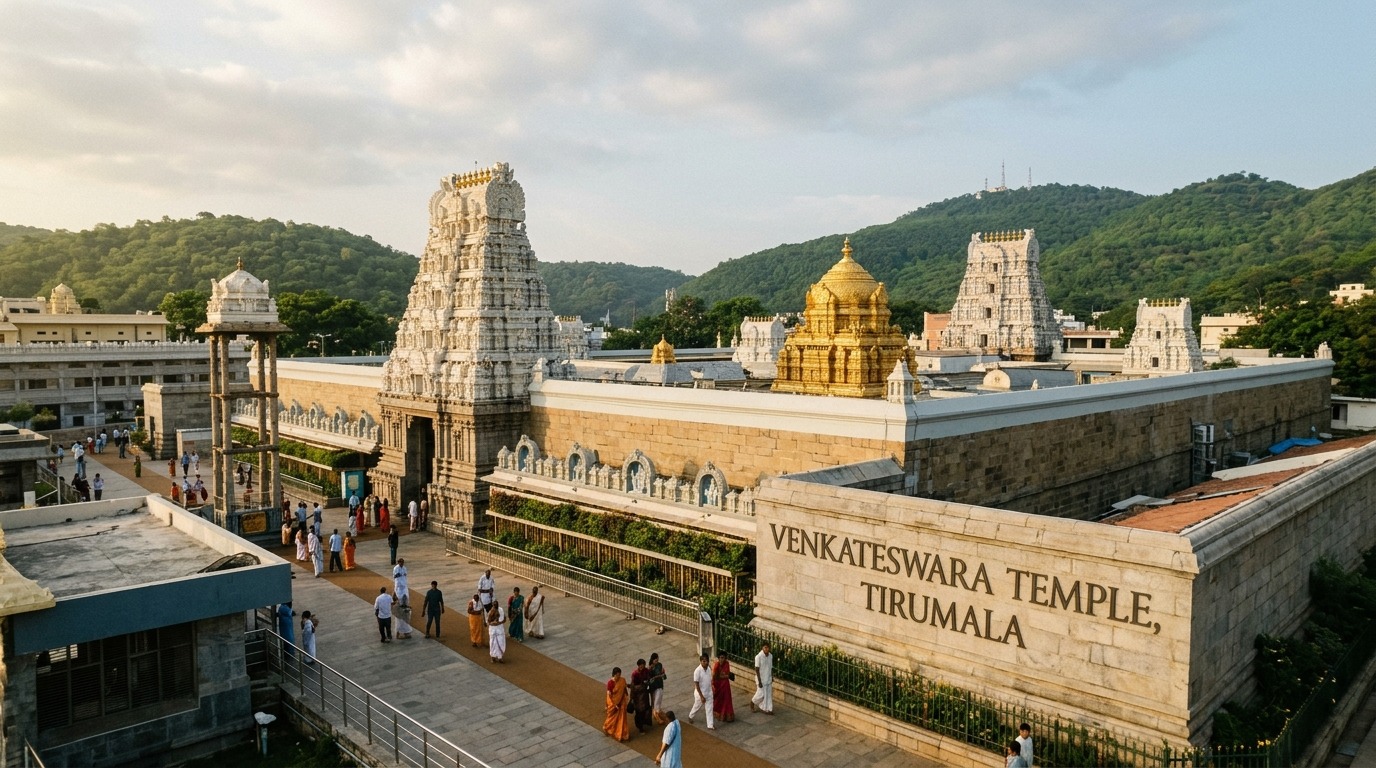
The Venkateswara Temple is one of India’s most famous Hindu pilgrimage sites and an important center of devotion to Lord Venkateswara, a form of Lord Vishnu. Located in the Tirumala Hills of Andhra Pradesh, the temple attracts millions of devotees who come to seek blessings and experience its rich spiritual traditions.
Also known as Tirumala Temple, Tirupati Temple, and Tirupati Balaji Temple, this sacred shrine is famous for its history, Dravidian architecture, religious traditions, and the large number of pilgrims who visit throughout the year. The temple is managed by Tirumala Tirupati Devasthanams (TTD), which oversees its religious and visitor services.
The Tirumala Hills are part of the Seshachalam range and are traditionally associated with seven sacred peaks. The temple stands on Venkatadri, the seventh hill, near the holy Swami Pushkarini. Because of these seven hills, the shrine is also widely known as the Temple of Seven Hills.
Temple legend
Several traditional stories explain why Lord Venkateswara is worshipped at Tirumala. According to Hindu tradition, Lord Vishnu came to earth in the form of Venkateswara during the Kali Yuga so that devotees could seek his protection and blessings.
One popular tradition connects the seven Tirumala Hills with the cosmic serpent Shesha. The hills are believed to represent the seven heads of Shesha, while Lord Vishnu is believed to have chosen this sacred place as his earthly home.
Another important legend is connected with Lord Varaha. According to the traditional account, Varaha, an incarnation of Vishnu, rescued the Earth from the cosmic waters. Tirumala was then regarded as Varaha Kshetra, a sacred land associated with Varaha.
There is also a well-known story involving Sage Bhrigu, Vishnu and Goddess Lakshmi. Bhrigu tested the great gods to determine who was most suitable to receive a sacred offering. When he approached Vishnu, he struck him on the chest. Vishnu responded calmly, but Lakshmi was deeply upset because the chest was considered her sacred place. She left Vaikuntha, and Vishnu eventually came to the Tirumala region. In later tradition, Lakshmi is associated with Padmavati, who became united with Venkateswara.
These legends are an important part of the spiritual identity of the Venkateswara Temple and continue to attract devotees interested in its religious history.
History of the temple
The history of the Tirumala temple developed over many centuries. Different South Indian rulers and dynasties contributed to the growth, maintenance, and decoration of the shrine.
Mention in Cilappatikaram
The sacred hill of Venkatam is mentioned in Cilappatikaram, one of the important classical Tamil literary works. The text describes the beauty of the hill and refers to the deity associated with the area.
This literary reference is significant because it shows the long-standing religious importance of the Tirumala region in South Indian tradition.
Medieval history
One of the earliest recorded temple endowments is associated with Pallava queen Samavai in 966 CE. She is traditionally credited with donating land, jewels, and resources for religious activities and festivals.
Later, the Cholas, Pandyas, Reddi rulers, and Vijayanagara rulers also contributed to the temple. The Vijayanagara period was particularly important in the development of the shrine. Large donations of gold, precious stones, and other valuables helped expand and decorate the temple.
Vijayanagara ruler Krishnadevaraya was a major patron of the shrine. His visits and donations played an important role in the temple’s development. The gold-covered roofing of the Ananda Nilayam is also connected with historical renovations during this period.
After the Vijayanagara Empire declined, several other rulers and regional leaders continued to support the temple. Maratha general Raghoji I Bhonsle also established arrangements for temple administration and donated valuable ornaments.
Ramanujacharya’s visits

The famous Vaishnava teacher Ramanujacharya is traditionally associated with Tirumala and is said to have visited the region several times.
His visits are important in the religious history of the temple because he helped organize worship practices according to Vaishnava traditions. He is also associated with the introduction and strengthening of devotional recitations and temple services.
Ramanujacharya’s influence remains part of the religious traditions followed at Tirumala today.
Modern history
The temple passed through different forms of administration during the later medieval and colonial periods. After the decline of the Vijayanagara Empire, the shrine came under the influence of different regional authorities.
During British rule, arrangements were introduced for managing the temple and its finances. In the 19th century, the administration was transferred to the Mahants of Hathiramji Mutt.
A major change came in 1933, when the Tirumala Tirupati Devasthanams was established under legislation to manage the temple and its associated institutions.
Today, TTD continues to oversee the administration of the temple and provides various facilities for pilgrims, including accommodation, food services, queue management, and religious services.
The temple also preserves a large collection of inscriptions and devotional material in languages such as Telugu, Tamil, Kannada, and Sanskrit. These records provide valuable information about the religious and cultural history of Tirumala.
Temple administration
The Tirumala Tirupati Devasthanams (TTD) is responsible for managing the Venkateswara Temple and many associated religious institutions.
The organization handles daily temple operations, pilgrim facilities, religious services, accommodation, food distribution, and crowd management. Because the temple receives a very large number of visitors, organized systems are essential for maintaining smooth movement and providing basic services.
TTD also operates charitable activities funded through temple resources and donations. The organization manages several facilities designed to support pilgrims during their visit.
Architecture
The Venkateswara Temple is an important example of South Indian temple architecture. Its design developed over several centuries, with contributions from different rulers and periods.
The temple complex contains large entrance towers, courtyards, halls, sacred spaces, shrines, and pathways used by pilgrims. Gold-covered architectural elements give the main shrine its distinctive appearance.
Dvarams and Prakarams
The temple has three main entrances leading toward the inner sacred area. These entrances are traditionally known as dvarams.
The surrounding areas are divided into different sections and courtyards. Each part has a specific role in the movement of pilgrims and temple rituals.
Mahadvaram
Mahadvaram is the main entrance of the temple. It is also known as Padikavali or Simhadvaram.
The entrance is located within the outer compound wall and provides access to the inner temple areas. The gateway tower is an important visual feature of the temple complex.
Traditional guardian figures known as Sankanidhi and Padmanidhi stand near the entrance and are associated with the protection of the temple’s sacred treasures.
Venḍi Vākili
Venḍi Vākili means “Silver Entrance” in Telugu. The name comes from the silver covering on its doors.
This entrance provides access to another section of the temple and lies beyond the outer entrance. Its decorated doors make it an important part of the temple’s interior architecture.
Baṁgāru Vākili
Baṁgāru Vākili means “Golden Entrance.” It is located closer to the main shrine and provides access toward the inner sacred area.
The entrance has images of Jaya and Vijaya, the traditional gatekeepers associated with Lord Vishnu. The doors are decorated with representations connected with Vishnu’s avatars.
Suprabhatam, the traditional morning devotional hymn, is recited near this entrance.
Pradakshinas
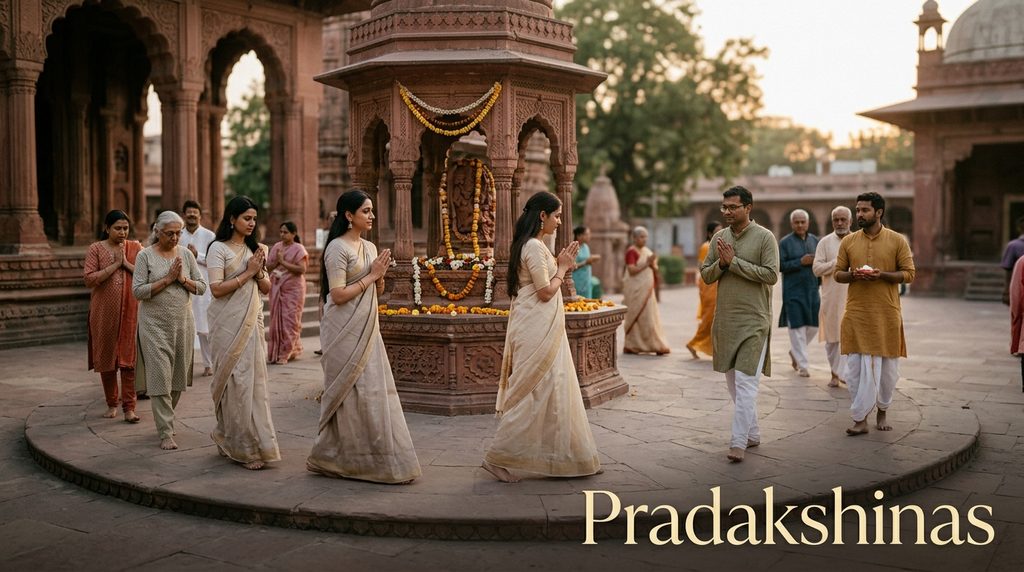
The temple complex contains enclosed pathways used for religious movement and circumambulation. These areas are surrounded by compound walls and connect different parts of the shrine.
Sampangi** **Pradakshina
Sampangi Pradakshina is one of the main circumambulatory areas inside the temple. Its name is connected with the Sampangi flower, which was traditionally grown in this part of the complex.
Several important halls and structures are located around this area.
- Pratima Mandapam: This hall contains statues associated with Vijayanagara rulers and other important figures.
- Ranga Mandapam: This hall has a historical connection with the Ranganathaswamy deity from Srirangam.
- Tirumalaraya Mandapam: Also known as Anna Unjal Mandapam, this structure is associated with temple festivals and historical Vijayanagara rulers.
- Saluva Narasimha Mandapams: These smaller halls are positioned around the surrounding area.
- Aina Mahal: Also called the Palace of Mirrors, this area contains mirrors that create repeated reflections and is associated with festival traditions.
- Dhvajasthamba Mandapam: This area surrounds the temple flagstaff and is located near the inner entrance.
Other storage and service areas are also located around this section of the temple.
Vimana** **Pradakshina
Vimana Pradakshina is the pathway around the main sanctum. Certain religious services are performed in this area.
Several important rooms and facilities are located along this pathway, including the temple kitchen, the golden well, service halls, record rooms, storage areas, and shrines.
The temple kitchen, known as Potu, prepares food used for religious offerings. Nearby is Bangaru Bavi, or the Golden Well, which traditionally supplies water for temple needs.
There is also a shrine connected with Sri Ramanuja. Another room preserves copper plates containing devotional compositions associated with Annamacharya and his descendants.
The temple’s Hundi, where devotees make donations, is also part of the temple complex.
Main Shrine
The main shrine is the most sacred section of the Venkateswara Temple. It contains several halls and leads toward the inner sanctum where the principal deity is worshipped.
Tirumamani** **Mandapam
Tirumamani Mandapam is an open-pillared hall located within the main shrine area. It has large temple bells and is connected with several important daily rituals.
The hall is associated with Koluvu Srinivasa and other religious ceremonies. It also has an important role during the annual Brahmotsavam celebrations.
A shrine dedicated to Garuda is located near this mandapam. Garuda is traditionally regarded as the vehicle and devoted servant of Lord Vishnu.
Snapana** **Mandapam
Snapana Mandapam, also known as Tiruvilankovil, is located after the Golden Entrance.
The hall contains pillars decorated in the Vijayanagara architectural style. It forms part of the route leading toward the innermost area of the shrine.
Garbhagriha
The Garbhagriha is the innermost sanctum of the temple. It houses the principal image of Lord Venkateswara.
The deity is traditionally regarded as self-manifested, meaning devotees believe the sacred image was not created or installed by an ordinary sculptor.
The sanctum has a carefully designed structure with surrounding walls and a pathway. Its architectural form reflects the development of South Indian temple design over many centuries.
Ananda Nilayam
Ananda Nilayam is the famous gold-covered structure located above the main sanctum.
It is one of the most recognizable features of the Venkateswara Temple. The structure has undergone renovations over different periods, and its golden appearance adds to the visual grandeur of the shrine.
The main deity stands directly beneath this sacred architectural structure.
Pushkarni
Swami Pushkarini is the sacred temple tank located near the main shrine. Hindu tradition connects the tank with Garuda and considers its water spiritually important.
The Pushkarini is also connected with temple festivals and religious ceremonies. A mandapam was historically constructed in the center of the tank, and special rituals are performed here on important occasions.
The annual float festival, known as Theppotsavam, is associated with the sacred tank. During the festival, processional deities are taken across the water on a decorated float.
Akhilandam

Akhilandam, also called Akhandam, is located in front of the main temple. It is known for its large lamps and devotional offerings.
Devotees traditionally offer camphor and prayers at this sacred area. Coconuts may also be offered according to temple customs.
The location provides devotees with a view of the temple and forms an important part of the traditional experience around the main shrine.
Deities in the temple
Venkateswara, a form of Vishnu, is the main deity worshipped at the temple. The main idol, known as the Moolavirat, is traditionally believed to have appeared on its own rather than being created by humans.
Pancha berams
According to the Vaikhanasa tradition, Venkateswara is represented by five main forms or idols. Together, these are called the Pancha Beramulu. The word Pancha means five. All five are kept inside the main sanctum beneath the Ananda Nilayam Vimana.
- Moolavirat or Dhruva Beram – The main idol of Venkateswara stands in the center of the sanctum on a lotus-shaped base. The deity has four arms, with two holding the conch and discus, while the other two are shown in traditional blessing and waist-level positions. The idol is richly decorated with sacred marks, jewels and ornaments, including a diamond crown, earrings, serpent ornaments and special garlands. Lakshmi is represented on the chest of the main idol as Vyuha Lakshmi.
- Bhoga Srinivasa or Kautuka Beram – Bhoga Srinivasa is a small silver idol measuring about one foot in height. It was donated to the temple in 614 CE by Pallava queen Samavai. The idol is placed close to the left foot of the main deity and remains connected to it by a sacred thread. Many daily services are performed for this idol on behalf of the main deity. It is also used during the daily Ekanta Seva and receives the Sahasra Kalasabhishekam on Wednesdays.
- Ugra Srinivasa or Snapana Beram – This idol represents the powerful and fierce form of Venkateswara. It was once used as the main processional idol but was later replaced by Malayappa Swami around 1330 CE. Today, Ugra Srinivasa normally remains inside the main shrine. It is taken outside only once a year during Kaishika Dwadasi, before sunrise. A special sacred bath is also performed for this idol on behalf of the main deity.
- Malayappa Swami or Utsava Beram – Malayappa Swami is the main festival and procession idol of the temple. He is accompanied by his two consorts, Sridevi and Bhudevi. This form of the deity takes part in many important celebrations and temple events, including Brahmotsavams, Kalyanotsavam, Dolotsavam, Vasanthotsavam, Sahasra Deepalankarana Seva, Padmavati Parinayotsavams, Pushpapallaki and other major festivals.
- Koluvu Srinivasa or Bali Beram – Koluvu Srinivasa is considered the temple’s guardian deity. The idol is connected with the daily administration and financial matters of the temple. Each morning, the previous day’s income, offerings and expenses are presented before the deity during Koluvu Seva. The day’s religious calendar is also announced, including the lunar date, sunrise, sunset and star of the day.
Other murtis
Apart from the five main idols, the temple also has several other sacred images. The main shrine contains metal idols of Sita, Rama, Lakshmana, Rukmini, Krishna and Chakratalvar. Separate smaller shrines are dedicated to Garuda, Narasimha, Varadaraja, Kubera and Hanuman.
Other sacred figures found in the temple include Shesha, Viswaksena, Sugriva and Ramanuja. A smaller image of Venkateswara, known as Vimana Venkateswara, is also carved into the northwest side of the second level of the Ananda Nilayam Vimana.
Worship
Puja
The temple follows the Vaikhanasa style of worship, an old Hindu tradition focused on Vishnu and his forms. The daily worship includes several rituals performed at different times of the day.
The day begins before sunrise when the lamps in the main shrine are lit and Venkateswara is ceremonially awakened with the Suprabhatam. This is followed by Thomala Seva, during which the deity is decorated with flowers.
Koluvu Srinivasa is then brought to the Tirumani Mandapam, where the previous day’s temple accounts are presented. The priests perform Archana while reciting the thousand names of Vishnu. The first food offering of the day, called Balabhogam, is then made.
At noon, another food offering known as Raja Bhogam is presented. From around midday, Kalyanotsavam is performed using the Malayappa Swami idol. Evening services include Dolotsavam, Arjita Brahmotsavam, Vasanthotsavam and Sahasra Deepalankarana Seva.
The final services take place at night. During Ekanta Seva, the deity is symbolically put to rest. Weekly services are also held from Monday through Friday:
- Visesha Pooja (Monday): Priests perform a special bathing ceremony using 14 vessels. This service was once held every week but is now mainly observed as an annual event during Vasant Panchami.
- Ashta Dala Padapadmaradhana (Tuesday): The service begins after the second bell. Priests recite the names of Venkateswara while offering 108 golden lotus flowers, one for each name. Worship is also offered to Lakshmi and Alamelu Manga before the final aarti.
- Sahasra Kalasabhishekam (Wednesday): This special service is performed for the silver Bhoga Srinivasa idol. The idol is brought near the main entrance and connected to the main deity with a silk thread. It is then bathed with holy water from 1,008 silver vessels and one golden vessel while sacred prayers are recited.
- Thiruppavada Seva (Thursday): During this service, the main deity is dressed more simply and many of the usual ornaments are removed. The eyes of the deity become more visible, which is why this occasion is also associated with Netra Darshanam. A large amount of tamarind rice and other sweets is offered before the deity.
- Poolangi Seva (Friday): After the Thursday rituals, the temple is cleaned and the main deity is dressed in a velvet covering and decorated with beautiful flower garlands.
- Abhishekam (Friday): A special sacred bath is performed for Venkateswara after the morning services. Water from Akasa Ganga is used first, followed by milk, sandalwood and other fragrant substances. Sacred prayers are recited throughout the ceremony. A separate turmeric offering is also made for the image of Goddess Lakshmi on the chest of the main deity.
The temple follows both major traditions within Sri Vaishnavism in different aspects of worship. Priests and religious teachers from established Vaishnava institutions also have important roles in temple activities.
During Dhanurmasam, which falls roughly from mid-December to mid-January, some daily practices change. The usual Suprabhatam is replaced by Tiruppavai, a devotional work associated with Andal. One section is recited each day for 30 days.
During this period, Venkateswara is worshipped in the form of Krishna. A silver Krishna idol is used during the night service instead of Bhoga Srinivasa. Flower offerings and food offerings also change during this month.
The temple becomes especially busy during Vaikunta Ekadasi. During this period, the special Vaikunta Dwaram is opened for devotees. Traditionally, passing through this entrance is believed to bring special blessings. Religious scholars also recite the Nalayira Divya Prabandham during the 21-day Adhyayana Utsavam.
Naivedhyam
Food offered to the deity is an important part of temple worship. The famous Tirupati Laddu is given to devotees as prasadam. The laddu has a Geographical Indication tag, and its production and sale are officially associated with Tirumala Tirupati Devasthanams.
The temple offers many other foods as well. These include sweet pongal, tamarind rice, curd rice, kadambham and other rice dishes. Other offerings include laddu, vada, dosa, appam, jalebi, murukku, poli and payasam.
Free meals are also provided to pilgrims every day. On Thursdays, a special Thiruppavada Seva takes place. During this ritual, a very large quantity of tamarind rice is arranged in a pyramid-like pile and offered to Venkateswara.
Darshan
Because millions of devotees visit the temple, special systems are used to manage the crowds. Vaikuntam Queue Complexes provide waiting areas where pilgrims can sit until their turn for darshan.
According to tradition, devotees are encouraged to visit the Bhuvaraha Swamy Temple near Swami Pushkarini before going for Venkateswara’s darshan.
A separate system is also available for pilgrims who reach Tirumala on foot. Limited biometric tokens are issued for this queue, and pilgrims receive a specific time for darshan. The two main walking routes are Alipiri Mettu and Srivari Mettu. Alipiri Mettu is available throughout the day, while Srivari Mettu operates during set daytime hours.
The temple offers different types of darshan to help handle the large number of visitors.
Sarva Darshan (Free Darshan): This is the general darshan option available without a special payment. It is the most widely used option. Depending on the number of visitors, festivals and other factors, devotees may have to wait for several hours before reaching the main deity.
Hair tonsuring
Many devotees shave their heads at Tirumala as an offering to Venkateswara. This practice is known as Mokku. A very large quantity of hair is collected at the temple every day, and the collected hair is later sold in international markets.
A traditional story connects this practice with Neela Devi. According to the legend, Venkateswara once suffered a bald spot on his head after being struck by a cowherd. Neela Devi noticed this and gave a part of her own hair to cover the bald area. Venkateswara was touched by her sacrifice and promised that devotees visiting his sacred home would offer their hair, which would be received by Neela Devi.
The hill called Neeladri is traditionally associated with Neela Devi.
For many years, male barbers from the Nai community mainly performed the tonsuring service. This created difficulties for women who wanted female barbers. After a campaign led by Kagganapalli Radha Devi, the temple agreed to appoint women barbers. Devi was later recognised for her work, receiving the Nari Shakti Puraskar from the President of India in 2019.
Hundi (donation pot)
The temple’s Hundi is the main place where devotees leave monetary offerings. A traditional story connects these donations with the wedding of Srinivasa and Padmavathi.
According to the legend, Srinivasa needed money for his marriage and received a large loan from Kubera. Because of this story, devotees believe that donating money to Venkateswara’s Hundi helps repay the traditional debt to Kubera.
The Hundi receives a very large amount of money from pilgrims. Daily collections can reach millions of rupees.
Thulabaram
Thulabaram is a traditional offering in which a devotee sits on one side of a large weighing scale. Items are placed on the other side until their weight is greater than or equal to the devotee’s weight.
People may offer items such as sugar, jaggery, tulsi leaves, bananas, coins or gold. The ritual is especially common for babies and young children.
Festivals
The Venkateswara Temple observes hundreds of religious events throughout the year. Because celebrations take place so frequently, Tirumala is often described as a place where almost every day brings a festival.
Sri Venkateshwara Brahmotsavams

Sri Venkateswara Brahmotsavams is one of the biggest annual celebrations at the temple. It is a nine-day festival generally held around October.
During the festival, Malayappa Swami travels through the streets around the temple along with Sridevi and Bhudevi. The deities are carried on different ceremonial vehicles, known as vahanams.
These include the Pedda Sesha Vahanam, Chinna Sesha Vahanam, Hamsa Vahanam, Simha Vahanam, Kalpavriksha Vahanam, Garuda Vahanam, Hanumantha Vahanam, Golden Chariot, Gajavahanam, Rathotsavam and Ashwa Vahanam.
Garuda Vahanam is especially popular and attracts huge crowds of devotees.
Vaikunta Ekadasi
Vaikunta Ekadasi is one of the most important festivals for devotees of Vishnu. It is believed that a special entrance known as the Vaikunta Dwaram opens on this day.
Thousands of devotees visit Tirumala to receive darshan through this special entrance. The temple can become extremely crowded, with very large numbers of pilgrims arriving on the same day.
Rathasapthami
Rathasapthami is another major celebration held around February. On this day, Malayappa Swami is taken around the temple in a procession.
The deity is carried on seven different ceremonial vehicles throughout the day, beginning in the morning and continuing into the night.
Other annual celebrations include Rama Navami, Janmashtami, Ugadi, Teppotsavam, Sri Padmavati Parinayotsavams, Pushpa Yagam, Pushpa Pallaki and Vasanthotsavam. These events are celebrated with special prayers, decorations and processions.
Songs and hymns
Venkateswara Suprabhatam is the early-morning devotional service performed to awaken Venkateswara. It takes place before sunrise inside the temple. The word “Suprabhatam” means a good or auspicious morning.
The hymns were composed by Prathivadhi Bhayankaram Annangaracharya and are traditionally dated to the 13th century. The collection contains 70 verses divided into four sections: Suprabhatam, Stotram, Prapatti and Mangalasasanam.
The hymns praise Venkateswara and ask for blessings for devotees.
Another important name in the temple’s musical tradition is Tallapaka Annamacharya, also known as Annamayya. He was a Telugu poet and devoted follower of Venkateswara. He composed thousands of devotional songs dedicated to the deity.
His compositions are written mainly in Telugu and Sanskrit and are commonly grouped into different types based on their themes, including devotional and romantic compositions.
The Seven Hills
The Venkateswara Temple stands among seven sacred hills. Because of this, Venkateswara is also known as the Lord of the Seven Hills.
These hills are traditionally connected with the seven hoods of Adisesha, the serpent associated with Vishnu. The seven hills are:
- Vrushabhadri — The hill connected with Vrishabasura, who is traditionally believed to have been defeated by Srinivasa.
- Anjanadri — The hill associated with Hanuman.
- Neeladri — The hill connected with Neela Devi.
- Garudadri or Garudachalam — The hill associated with Garuda, the vehicle of Vishnu.
- Seshadri or Seshachalam — The hill associated with Sesha, the serpent and servant of Vishnu.
- Narayanadri — The hill associated with Narayana. The sacred footprints of Venkateswara, known as Srivari Padalu, are located here.
- Venkatadri — The hill associated with Venkateswara and the main temple.
Varadaraja Temple
A small shrine dedicated to Varadaraja is located inside the Vimana-pradakshina area, on the left side of the silver entrance when entering the temple.
The exact date when the shrine was established is not known. The stone image of Varadaraja is shown sitting and facing west.
Yoga Narasimha Temple
A small shrine dedicated to Narasimha stands in the northeastern part of the Vimana-Pradakshina area.
The shrine is traditionally believed to date from the period between 1330 and 1360 CE. The Yoga Narasimha image is shown sitting with crossed legs. The deity has the conch and discus in the upper hands, while the lower hands are placed in a traditional meditation position.
Garuthmantha Temple
A small shrine dedicated to Garuda, the traditional vehicle of Venkateswara, stands directly opposite the Golden Entrance.
The shrine forms part of the Garuda Mandapam. The image of Garuthmantha is about six feet tall and faces west toward Venkateswara in the main shrine.
Bhuvaraha Swamy Temple
The Bhuvaraha Swamy Temple is dedicated to Varaha, an incarnation of Vishnu. It is traditionally believed to be older than the main Venkateswara Temple.
The shrine is located on the northern side of Swami Pushkarini. According to temple tradition, food should first be offered to Bhuvaraha Swamy before it is offered to Venkateswara.
Devotees are also traditionally encouraged to receive darshan at the Bhuvaraha Swamy Temple before visiting the main Venkateswara shrine.
Bedi-Anjaneya Temple
Bedi-Anjaneya Temple is a small shrine dedicated to Hanuman. It is located directly opposite the main temple entrance near Akhilandam, where devotees traditionally offer coconuts.
The image of Hanuman here is shown with both hands bound. The Telugu word “Bedilu” refers to these hand restraints.
Vakulamatha Sannidhi
Vakulamatha is traditionally regarded as the mother of Venkateswara. Her shrine is located inside the main temple, near the Varadaraja shrine.
Her image is shown in a sitting position. According to tradition, she looks after the preparation of food offered to Venkateswara. A small opening in the wall connects her shrine with the temple kitchen, allowing the traditional connection between her and the food preparation area.
Kubera Sannidi
A small shrine dedicated to Kubera is located inside the Vimana-pradakshina area.
The shrine is positioned to the right of the main sanctum, and the image of Kubera faces south toward the main deity.
Ramanuja Shrine

The shrine dedicated to Sri Ramanuja is located near the northern passage of the Vimana Pradakshinam. It is also known as the Bhashyakara Sannidhi.
The shrine is traditionally dated to around the 13th century CE and honours Ramanuja’s important role in Sri Vaishnava tradition.
Notable devotees
Ramanuja (1017–1137) was one of the most important teachers of Sri Vaishnavism. He played a major role in organising worship practices and other temple activities at Tirumala.
He is also traditionally associated with presenting the sacred conch and discus, the symbols of Vishnu, during his visit. A shrine dedicated to Ramanuja stands inside the temple and is traditionally connected with Sri Ananthalwan. He also established the Pedda Jeeyar Matam.
Sri Tallapaka Annamacharya (Annamayya) was a famous Telugu poet and devotional singer who lived from 1408 to 1503. He served the Tirumala temple through his devotional music and composed thousands of songs praising Venkateswara.
Hathiram Bhavaji was a saint from Ayodhya who is traditionally believed to have visited Tirumala around 1500 CE. He later became a devoted follower of Venkateswara.
Tarigonda Vengamamba (1730–1817) was a poet and devoted follower of Venkateswara. She wrote several religious works, including the Sri Venkatachala Mahatyam.
Her devotion is remembered through the Harathi performed during Ekanta Seva in her honour. The Annaprasadam centre at Tirumala is also named after her.
Religious significance
The temple is regarded as one of the eight Swayambhu Kshetras of Vishnu. In this tradition, the main deity is believed to have appeared naturally rather than being created by humans.
The other temples traditionally included in this group are Srirangam Ranganathaswamy Temple, Bhu Varaha Swamy Temple, Vanamamalai Perumal Temple, Saligrama in Nepal, Naimisaranya, Pushkar and Badrinath Temple.
The temple is also highly respected in the writings of the Alvars, who praised Vishnu in the Divya Prabandham. Tirumala is recognised as one of the 108 Divyadesams, which are sacred Vishnu temples mentioned in these devotional works.
Ancient Hindu scriptures, including the Rig Veda and various Puranas, also contain references connected with Venkatachala. Many traditional stories describe Venkateswara as a deity who grants blessings and answers the prayers of devotees.
Nearby temples
Several important temples can be visited around Tirumala and Tirupati.
Sri Padmavathi Temple at Tiruchanur is dedicated to Padmavathi, who is traditionally regarded as the wife of Venkateswara. It is located about 5 km from Tirupati.
Srikalahasteeswara Temple at Srikalahasti is dedicated to Shiva and is associated with the air element in Hindu tradition. It is around 38 km from Tirupati.
Sri Varasiddhi Vinayaka Temple at Kanipakam is a historic temple dedicated to Vinayaka, or Ganesha. It is located around 75 km from Tirupati.
Within Tirupati city, visitors can also explore Govindaraja Temple, Kalyana Venkateswara Temple at Srinivasa Mangapuram, Kodandarama Temple and Kapila Theertham. These temples offer additional opportunities to experience the religious history and traditions of the Tirupati region.
FAQs
Who is the main deity of Venkateswara Temple?
Lord Venkateswara, a form of Lord Vishnu, is the main deity of the temple. Devotees visit the shrine to seek his blessings and receive darshan.
What are the seven hills of Tirumala?
The seven hills are Vrushabhadri, Anjanadri, Neeladri, Garudadri, Seshadri, Narayanadri, and Venkatadri. Together, they are known as Saptagiri.
Why do devotees offer their hair at Tirumala?
Many devotees offer their hair as an act of devotion and fulfillment of a personal vow. This practice is commonly known as Mokku.
What is special about Tirupati Laddu?
Tirupati Laddu is the famous prasadam given to devotees at the temple. It has a Geographical Indication (GI) tag and is closely associated with Tirumala Temple.
What is the most important festival at Venkateswara Temple?
Sri Venkateshwara Brahmotsavams is one of the temple’s biggest annual festivals. Vaikunta Ekadasi is another major celebration that attracts huge numbers of devotees.
Conclusion
Venkateswara Temple in Tirumala is much more than a famous pilgrimage site. Its sacred idols, daily worship, traditional offerings, festivals, devotional songs, seven holy hills, and nearby shrines make it an important spiritual destination. From receiving darshan of Lord Venkateswara to exploring the temple’s long-standing traditions, every part of the visit offers a deeper connection with South India’s religious heritage. Whether you visit for worship, culture, or spiritual experience, Tirumala remains one of India’s most meaningful pilgrimage destinations.
Read More: Badrinath vs. Kedarnath – Which Temple is Harder to Reach?

I am a travel enthusiast who loves exploring India’s beautiful destinations, culture, history, food, and hidden places. Through my travel website, I aim to help travelers discover amazing places in India and plan memorable trips with useful travel information and tips.