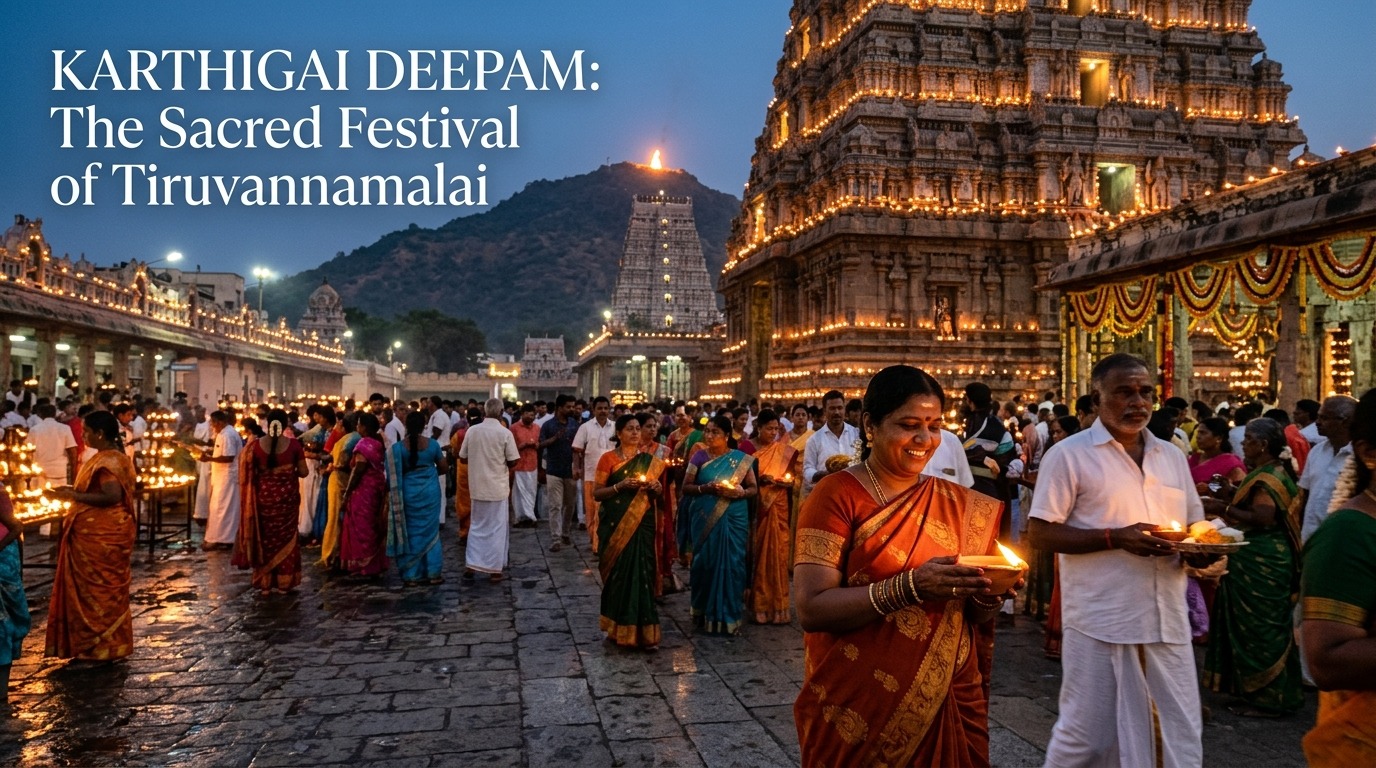
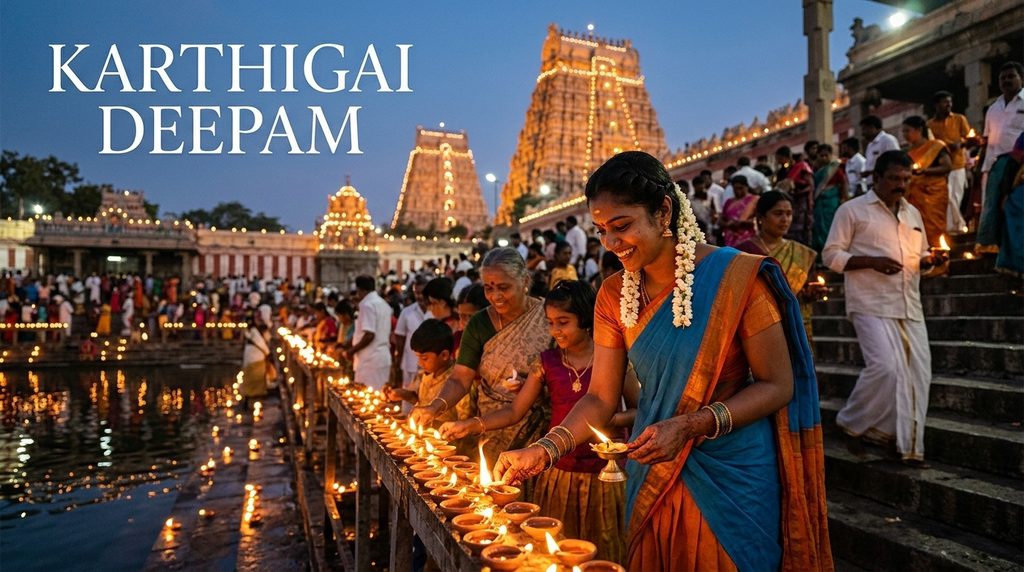
As the Tamil month of Karthigai reaches its full-moon celebration, Tiruvannamalai takes on a remarkable religious atmosphere. Thousands of lamps illuminate homes, streets, shrines, and temple spaces, while the sacred Arunachala Hill becomes the focus of an ancient fire tradition. At the centre of the celebration is the great Mahadeepam, whose flame on the summit of the hill can be seen across the surrounding landscape. (Tiruvannamalai District)
For travelers, this is much more than a festival of lights. The celebration connects temple rituals, Shaiva traditions, processions, pilgrimage, and the distinctive geography of Tiruvannamalai. Understanding what happens before the main lighting, why the hill matters, how Girivalam fits into the occasion, and what visitors should expect can make a festival journey far more meaningful.
Why the Festival Is So Important in Tiruvannamalai
Tiruvannamalai holds a special place in Tamil Shaiva tradition because Arunachala Hill is revered as a manifestation of Lord Shiva associated with fire, or Agni. The district administration describes the town as one of Tamil Nadu’s most venerated religious centres, with the hill and its surroundings held in high regard for centuries. (Tiruvannamalai District)
The annual celebration brings this symbolism into public view. The lighting of the great flame on the hill is not simply a spectacular visual event; it represents the sacred fire associated with Shiva and forms the central spiritual moment of the festival.
This explains why visitors encounter such a strong sense of pilgrimage throughout the town. Streets, temple precincts, and the circumambulation route become part of a much larger religious gathering.
The Legend Behind the Sacred Flame
One of the best-known traditions tells of Lord Shiva appearing as an immeasurable column of fire when Brahma and Vishnu disputed their supremacy. Unable to find either the beginning or end of this manifestation, the two deities recognized the limits of their search.
According to the Tiruvannamalai district’s account, Shiva’s fiery manifestation became associated with the sacred hill of the region. The names Arunachala and Tiruvannamalai are themselves connected with the idea of a holy fire hill. (Tiruvannamalai District)
The annual flame therefore carries a meaning that reaches beyond the visual symbolism of a lamp. For devotees, it recalls the divine presence of Shiva in the form of fire and the spiritual significance of Arunachala.
The Ten-Day Brahmotsavam
The main celebration is part of a larger ten-day Brahmotsavam held at the Annamalaiyar Temple. The festival includes processions of the deities and a sequence of religious events leading toward the principal Deepam day. (Tiruvannamalai District)
For visitors arriving before the final day, this extended program offers a different perspective. Instead of experiencing only the famous hilltop flame, travelers can observe how the celebration builds through temple rituals, processions, and community participation.
The schedule is not something to approach casually, however. Specific ceremonies and timings can vary according to the official annual program, so anyone planning a festival trip should check the latest announcements from the temple or district administration.
What Happens on the Main Festival Day
The final day contains several important stages, beginning before sunrise. The district’s official description records the lighting of Bharani Deepam in the temple during the early morning, followed later by the preparation for the evening Mahadeepam. (Tiruvannamalai District)
The sequence gives the day a distinctive rhythm. Early rituals take place within the temple before attention gradually shifts toward the hill and the evening ceremony.
By late afternoon, the atmosphere changes dramatically as pilgrims gather in anticipation of the main lighting. The exact arrangements can be affected by crowd-management and administrative measures, so travelers should rely on current official information rather than assuming that previous years’ procedures will remain unchanged.
Bharani Deepam and Its Religious Meaning
Bharani Deepam is one of the significant rituals associated with the final day. According to the district administration’s description, a ceremonial flame is lit inside the temple during the early morning and is used in subsequent lamp-lighting rituals. (Tiruvannamalai District)
The ritual has its own religious importance and should not be treated merely as a smaller version of the evening event. It forms part of the theological and ceremonial progression of the festival.
For visitors interested in the religious dimension, learning about Bharani Deepam beforehand can make the morning ceremonies easier to appreciate.
The Mahadeepam on Arunachala Hill
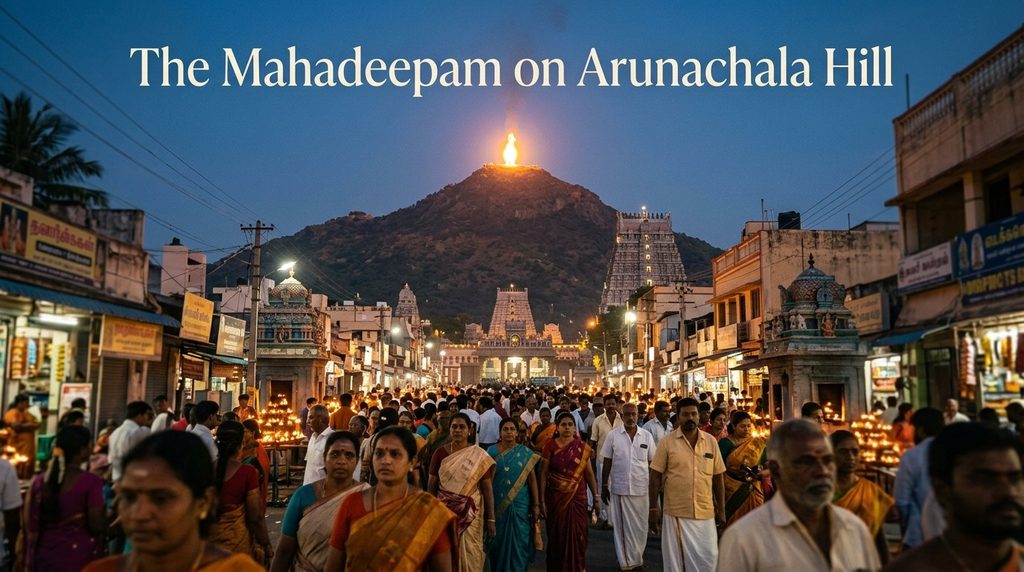
The defining moment comes in the evening when the great Mahadeepam is lit on Arunachala Hill. The official district tourism information identifies the hill as approximately 2,669 feet high and notes that the flame can be viewed from many kilometres around the mountain. (Tiruvannamalai District)
The lighting takes place in conjunction with important temple proceedings. The district’s official Tamil-language description states that the Mahadeepam is lit on the mountain at the same time as an associated temple flame, creating the central visual and religious moment of the celebration. (Tiruvannamalai District)
For someone seeing the event for the first time, the experience is striking precisely because the flame is part of a much larger landscape. The hill is already a sacred presence throughout the year; during the festival, its summit becomes the focal point of an enormous gathering.
Temple Rituals, Processions, and the Festival Atmosphere
The celebration extends beyond the single moment when the hilltop flame appears. Temple processions and ritual activities take place throughout the festival period, creating a continuous sense of movement around Tiruvannamalai. (Tiruvannamalai District)
The district also highlights the Periya Ther, or large temple chariot, as an important feature of the festival. (Tiruvannamalai District)
Travelers should expect crowded streets, devotional activity, temporary arrangements, and a strong pilgrimage atmosphere. This is not the ideal occasion for visitors seeking an ordinary sightseeing trip with predictable traffic and quiet temple surroundings.
Girivalam During the Festival
Girivalam is the traditional circumambulation of Arunachala Hill. The official district tourism information describes the route as approximately 14 kilometres and notes that very large numbers of devotees undertake the walk on full-moon and festival days. (Tiruvannamalai District)
Because the principal celebration is connected with the full moon in the Tamil month of Karthigai, the walking route can become exceptionally crowded. Pilgrims may begin their circuit at different times, creating sustained movement around the mountain.
| Festival Activity | What Visitors Should Expect |
| Temple rituals | Multiple ceremonies throughout the festival |
| Bharani Deepam | Early-morning ritual on the principal day |
| Temple processions | Religious processions during the festival period |
| Mahadeepam | Main evening flame on Arunachala Hill |
| Girivalam | Large-scale circumambulation of the hill |
| Periya Ther | Major temple chariot associated with the festival |
Best Time to Visit
If your main purpose is to experience the festival itself, the most important period is the annual Karthigai celebration in Tiruvannamalai, culminating in the full-moon Deepam day. The festival follows the Tamil religious calendar, so its date changes from year to year.
The most atmospheric period is also the busiest. The district administration notes that lakhs of devotees gather for the Mahadeepam and Girivalam, making crowd levels exceptionally high. (Tiruvannamalai District)
Travelers who prefer a calmer experience may find it more comfortable to visit Tiruvannamalai outside the main festival period. Cooler weather can also make walking and outdoor exploration more manageable, although conditions should be checked close to the trip.
For a festival visit, planning matters more than simply choosing a date. Confirm the official annual schedule, transport arrangements, accommodation availability, and any temporary visitor restrictions before traveling.
How to Plan a Festival Visit
A festival pilgrimage requires a different approach from an ordinary temple visit. Accommodation and transport should be arranged as early as practical because demand can rise sharply around the main celebration.
Keep your schedule flexible. Road congestion, pedestrian movement, security arrangements, and crowd-control measures can affect journey times, particularly near the temple and Girivalam route.
It is also sensible to carry only essential belongings when entering crowded areas. Comfortable clothing, suitable footwear for walking, drinking water, and a charged phone are practical basics for spending long hours around the festival.
Most importantly, follow instructions issued by local authorities and temple officials. Arrangements can change from one year to another depending on crowd size and public-safety requirements.
Where to Experience the Celebration
The main temple area is naturally central to the festival, but the celebration spreads throughout Tiruvannamalai. The hill, surrounding roads, temple streets, and Girivalam route all become part of the pilgrimage environment.
There is no single viewpoint that defines the entire experience. Some visitors may focus on temple rituals, while others are interested in seeing the hilltop flame or experiencing the circumambulation tradition.
If you are unfamiliar with the town, avoid improvising your entire visit around the last few hours of the main day. Understanding the geography beforehand will help you move between locations more calmly.
Travel Options for Tiruvannamalai
Tiruvannamalai can be reached by road and rail, making it accessible from other parts of Tamil Nadu and neighbouring regions. During the major festival, however, ordinary journey times should not be assumed.
| Travel Consideration | Practical Advice |
| Rail | Check current train schedules before booking |
| Bus | Confirm festival-period services and departure points |
| Private vehicle | Allow substantially more time because of crowd and traffic conditions |
| Local movement | Expect pedestrian congestion near major religious areas |
| Festival travel | Book essential arrangements early and monitor official updates |
Because special traffic arrangements may be introduced during the celebration, current local announcements are more reliable than older travel guides. The district’s tourism portal maintains dedicated information about the festival and Tiruvannamalai attractions. (Tiruvannamalai District)
Nearby Spiritual and Cultural Experiences
A festival trip can be extended beyond the principal celebration. Tiruvannamalai is closely associated with Arunachala Hill, Girivalam, the Annamalaiyar Temple, and the spiritual legacy of figures such as Ramana Maharshi.
Visitors interested in the broader character of the town can explore its religious institutions and surrounding sacred landscape when crowd conditions permit. The district administration identifies Tiruvannamalai as an ancient heritage and Saiva centre, reflecting the depth of its cultural significance. (Tiruvannamalai District)
During the main festival, however, the priority should be allowing sufficient time for the central events rather than trying to fit too many additional attractions into one day.
What Visitors Should Remember
The festival is first and foremost a religious celebration. Photography, sightseeing, and travel interests are secondary to the rituals taking place around you.
Dress respectfully, remain patient in crowded areas, and avoid obstructing religious processions or pilgrims. If an area is temporarily restricted, follow the instructions rather than attempting to find an alternative route into a controlled space.
The best travel experience comes from recognizing that you are entering a living tradition rather than attending a staged performance. That distinction changes how the crowds, rituals, sounds, and long periods of waiting feel.
Why This Festival Leaves a Lasting Impression
The extraordinary quality of the celebration comes from its setting. A monumental South Indian temple, an ancient sacred hill, a full-moon pilgrimage, and a single enormous flame come together within the same landscape.
The experience also unfolds gradually. Morning rituals establish the religious tone, temple processions maintain the sense of movement, devotees gather throughout the day, and the evening flame brings the celebration toward its most anticipated moment.
For travelers interested in culture and living traditions, that progression is more revealing than the spectacle alone. It shows how faith, place, community, and ritual continue to shape everyday life in Tiruvannamalai.
FAQs
Where is the festival celebrated?
The main celebration takes place in Tiruvannamalai, Tamil Nadu, centred on the Annamalaiyar Temple and sacred Arunachala Hill.
What is the main highlight of the celebration?
The principal highlight is the lighting of the Mahadeepam on Arunachala Hill during the evening of the main festival day. The flame is associated with Shiva’s manifestation as sacred fire. (Tiruvannamalai District)
What is Bharani Deepam?
Bharani Deepam is an important early-morning ritual held on the principal festival day at the temple. The ceremonial flame forms part of the sequence leading toward the evening celebration. (Tiruvannamalai District)
Is Girivalam performed during the festival?
Yes. Girivalam, the circumambulation of Arunachala Hill, is particularly significant during full-moon and festival periods. The official district tourism information describes the circuit as approximately 14 kilometres. (Tiruvannamalai District)
Should travelers book their trip in advance?
Yes. The main celebration attracts very large crowds, so arranging transportation and accommodation early is advisable. Visitors should also check the latest official announcements for traffic, access, and festival arrangements.
Conclusion
A journey to Tiruvannamalai during this annual festival is best approached as a pilgrimage experience rather than a conventional sightseeing excursion. The temple ceremonies, Bharani Deepam, processions, Girivalam, and hilltop Mahadeepam each contribute something different to the occasion.
Preparation is essential because the same features that make the celebration extraordinary also create enormous crowds and logistical challenges. Check official information, arrange travel early, keep your plans flexible, and approach the rituals with respect.
When the great flame finally appears above Arunachala Hill, its significance is rooted in everything that has come before it. That connection between sacred landscape, ancient tradition, and living community is what gives the festival its enduring power.
Read more:Arunachala Temple: A Spiritual Journey Through Tiruvannamalai

I am a travel enthusiast who loves exploring India’s beautiful destinations, culture, history, food, and hidden places. Through my travel website, I aim to help travelers discover amazing places in India and plan memorable trips with useful travel information and tips.