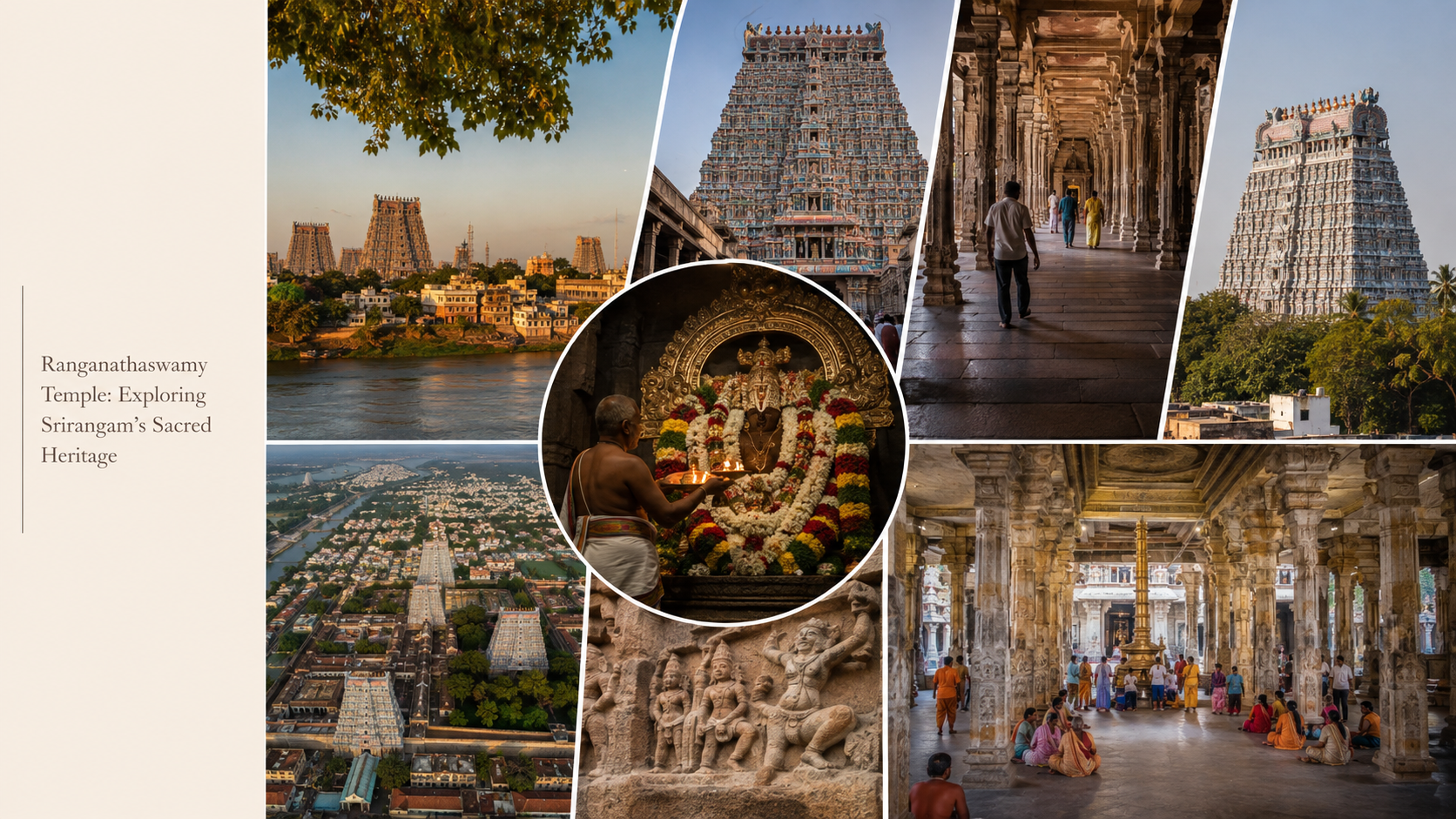
On an island formed by the Kaveri and Kollidam rivers near Tiruchirappalli, Srirangam unfolds around one of South India’s most remarkable sacred complexes. The temple town is not simply a place with a famous shrine; its streets, gateways, courtyards, and rituals have developed around the spiritual life of the deity for centuries.
The presiding form of Lord Vishnu is shown reclining on the serpent Adisesha, while the enormous complex reflects the architectural ambitions of successive South Indian dynasties. For travelers, the appeal lies in seeing how monumental architecture, Vaishnava traditions, festivals, and everyday life continue to exist together within a living temple town.
The Sacred Setting of Srirangam
Srirangam occupies an island between two branches of the Kaveri river system. Its geography has helped shape the identity of the settlement, with the temple complex becoming the dominant feature of the town.
The site is regarded as one of the most important Vaishnava pilgrimage destinations and is counted among the 108 Divya Desams dedicated to Lord Vishnu. The Ministry of Tourism describes Srirangam as a major pilgrimage centre and notes its traditional association with the idea of Vaikuntha, the heavenly abode of Vishnu.
A History Shaped by Many Dynasties
The present complex is the result of centuries of expansion rather than the work of a single ruler. Cholas, Pandyas, Hoysalas, Vijayanagara rulers, and Nayaks all contributed to its development at different stages.
The temple also experienced periods of conflict and disruption. Historical accounts preserved by Tamil Nadu Raj Bhavan describe the invasion of Srirangam in the fourteenth century and the efforts made to protect the principal deity and later restore worship at the shrine.
That layered history can still be sensed in the architecture. Different periods left behind gateways, halls, sculptures, inscriptions, and additions that now form one enormous religious landscape.

Seven Concentric Enclosures
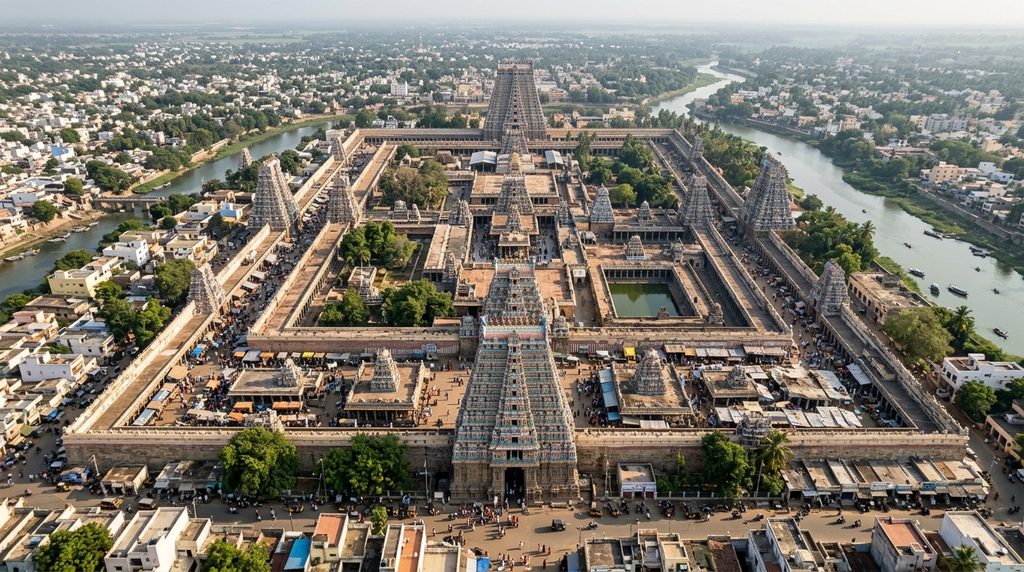
One of the defining features of the complex is its seven concentric enclosures, traditionally known as prakaras. These successive zones create a gradual movement from the outer town toward the most sacred areas.
Tamil Nadu government tourism information records seven walls and 21 gopurams within the complex. The arrangement is unusual in scale, making the temple feel almost like a fortified sacred city rather than a conventional standalone shrine.
Walking through the different enclosures is therefore part of the experience. The farther inward a visitor travels, the more the surroundings shift from the busy life of the temple town toward spaces devoted increasingly to worship.
The Towering Rajagopuram
The Rajagopuram is one of the most recognizable features of Srirangam. The massive gateway tower dominates the surrounding landscape and provides an immediate sense of the scale of the complex.
The Tiruchirappalli City Municipal Corporation describes it as a 13-tiered tower approximately 72 metres high and notes that it was completed in 1987. The remaining major gopurams belong to earlier periods, many dating between the fourteenth and seventeenth centuries.
For photographers and architecture enthusiasts, the tower is particularly striking when viewed from a distance, where its height becomes easier to appreciate against the relatively low-rise surroundings of the temple town.
The Reclining Form of Lord Ranganatha
At the spiritual centre of the complex is Lord Ranganatha, the reclining form of Vishnu resting upon the serpent Adisesha. This distinctive representation is central to the temple’s religious identity.
The deity is not simply an architectural object for visitors to observe. Daily worship, offerings, recitations, and ceremonial traditions continue within the complex, making the site a living centre of Vaishnava practice.
Travelers should therefore approach the inner areas with the same respect expected at any active place of worship.
Ramanuja and the Vaishnava Tradition
Srirangam has an important connection with the development of Sri Vaishnavism. Ramanujacharya, the influential philosopher associated with Vishishtadvaita Vedanta, is closely linked with the shrine and its religious tradition.
Tamil Nadu Raj Bhavan’s historical material also highlights the association of Vedanta Desika with the temple and the role of Tamil devotional compositions known as the Divya Prabandham in temple worship.
For visitors interested in Indian philosophy and religious history, this makes Srirangam particularly rewarding. Its importance extends beyond architecture into the history of ideas, devotional literature, and temple-based traditions.
Halls, Pillars and Sculptural Details
The complex contains numerous mandapams, pillars, carved surfaces, and ceremonial spaces. Rather than trying to absorb everything at once, visitors should slow down and examine smaller architectural details.
Look for differences in pillar design, sculptural treatment, gateway decoration, and the changing proportions of spaces as you move between enclosures. These details reveal how the complex developed over many generations.
The architecture is best appreciated at walking pace. A quick visit focused only on the principal shrine can easily miss the visual character of the wider complex.
Major Festivals and Temple Traditions
Festivals are an important part of life at Srirangam, and the annual calendar includes major Vaishnava celebrations. Vaikunta Ekadasi is among the most significant, taking place during the Tamil month of Margazhi, generally corresponding to December and January.
The Ministry of Tourism describes the festival period as involving Pagal Pathu and Ra Pathu, devotional recitations, processions, and the opening of Paramapada Vasal, often described as the gateway to heaven.
Panguni Uthiram is another important celebration. The Ministry of Tourism records the traditional Serthi Sevai, during which Ranganatha and Ranganayaki are ceremonially brought together.
Because festival periods can attract very large crowds, travelers should check the current temple schedule before planning a visit around a major celebration.
Best Time to Visit
For comfortable sightseeing, the cooler months are generally easier for exploring the extensive complex on foot. December through February can be particularly pleasant compared with the hotter part of the year.
The Margazhi season is attractive to travelers interested in religious ceremonies and devotional traditions, especially around Vaikunta Ekadasi. However, major festival days can be exceptionally busy, so visitors seeking a quieter architectural experience may prefer a less crowded period.
The hotter months can make extended walking uncomfortable, particularly because the complex is large and several areas are best explored slowly. Check current temple schedules and festival announcements before traveling, as ceremonial timings can vary.
Getting to Srirangam
Srirangam is part of the Tiruchirappalli urban region, making it relatively straightforward to include in a Tamil Nadu itinerary. The temple is approximately a few kilometres from Tiruchirappalli’s Rock Fort area, according to Tamil Nadu government municipal information.
Tiruchirappalli is the practical transport hub for travelers arriving by rail or air. From there, local road transport can be used to reach Srirangam.
| Travel Need | Practical Choice |
| Main transport hub | Tiruchirappalli |
| Air travel | Tiruchirappalli International Airport |
| Rail travel | Tiruchirappalli railway connections |
| Local access | Taxi, auto-rickshaw and local buses |
| Temple exploration | Walking is important within the large complex |
Exact transport schedules can change, so travelers should confirm current services before departure.
Nearby Places Worth Exploring
A visit to Srirangam can easily be combined with other attractions around Tiruchirappalli. The Rock Fort is one of the city’s best known landmarks, while the Jambukeswarar Temple at Thiruvanaikaval lies close to Srirangam. Tamil Nadu municipal information places the Shaiva temple roughly two kilometres east of Srirangam.
This makes it possible to experience two major religious traditions within a relatively compact area. Travelers interested in architecture can also use the wider Tiruchirappalli region as a base for exploring historic temples and monuments.
What Visitors Should Know
Srirangam is an active place of worship, so visitors should dress respectfully and follow instructions from temple authorities. Certain inner areas may have specific access arrangements, and schedules can change during festivals or special ceremonies.
It is also worth allowing more time than you might initially expect. The complex is extensive, and moving through its enclosures involves considerable walking.
Photography rules can vary by area. Rather than assuming that photography is permitted everywhere, follow the signs and instructions provided on site.
A Thoughtful Way to Explore the Complex
The best way to experience Srirangam is not to treat it as a monument that can be rushed through in a few minutes. Begin by understanding the overall layout, then gradually explore its gateways, streets, mandapams, shrines, and devotional spaces.
Architecture enthusiasts may want to concentrate on the gopurams and carved pillars, while travelers interested in religion and culture can pay closer attention to the rituals, recitations, and movement of devotees.
If possible, leave some unplanned time in the itinerary. The atmosphere of the temple town itself is an important part of the experience.
Conclusion
Srirangam offers a rare combination of monumental scale and continuing religious life. Its seven enclosures, towering gateways, historic layers, devotional traditions, and relationship with the Kaveri landscape make it far more than an architectural attraction.
A thoughtful visit should allow time for both the grand elements and the smaller details: a carved pillar, a quiet passage, a ceremonial sound drifting through the complex, or the movement of pilgrims between sacred spaces. That balance is what makes this ancient temple town memorable.
For travelers exploring Tamil Nadu’s religious and architectural heritage, Srirangam deserves a place on the itinerary not simply because of its size, but because its history and traditions remain part of everyday life.
FAQs
Where is the temple located?
The temple is located at Srirangam in the Tiruchirappalli region of Tamil Nadu, on an island between branches of the Kaveri river system.
What is the temple famous for?
It is famous for its dedication to Lord Vishnu in his reclining Ranganatha form, its seven concentric enclosures, numerous gopurams, and importance in Sri Vaishnavism.
How many gopurams are there?
Tamil Nadu government tourism information identifies 21 gopurams within the complex. The Rajagopuram is the largest and was completed in 1987.
When is the busiest festival season?
Margazhi, usually corresponding to December and January, is particularly important because of Vaikunta Ekadasi and associated celebrations. Large crowds gather during the major festival days.
What other attraction can be visited nearby?
The Jambukeswarar Temple at Thiruvanaikaval is very close to Srirangam, while Tiruchirappalli’s Rock Fort is another prominent nearby attraction.

I am a travel enthusiast who loves exploring India’s beautiful destinations, culture, history, food, and hidden places. Through my travel website, I aim to help travelers discover amazing places in India and plan memorable trips with useful travel information and tips.