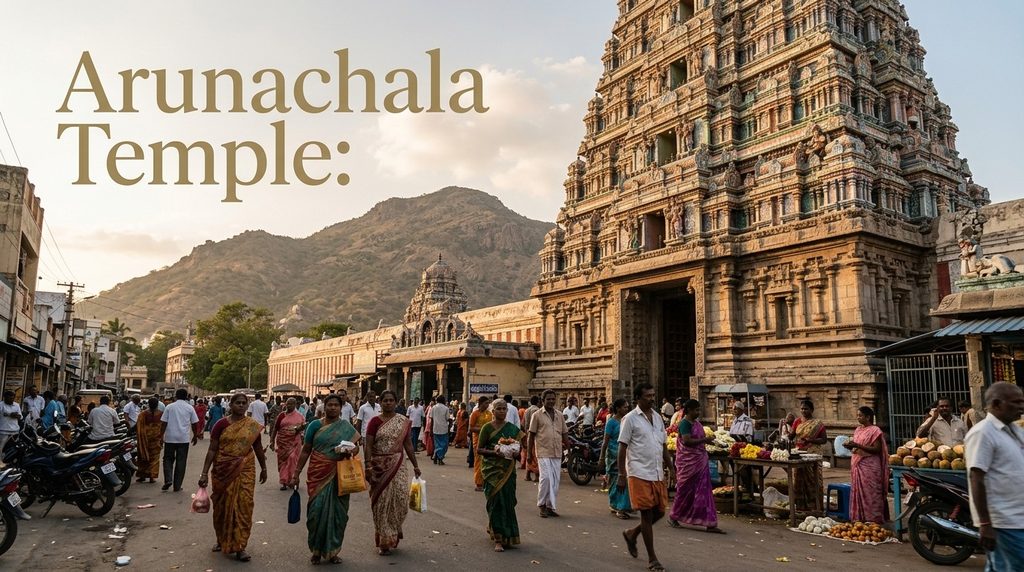
At the foot of the sacred Arunachala Hill in Tamil Nadu, this ancient Shaiva pilgrimage centre has shaped the identity of Tiruvannamalai for centuries. The soaring temple towers, vast courtyards, enduring rituals, and ever-present presence of the hill create an experience that feels inseparable from the landscape itself. A visit here is not simply about seeing an important monument; it is about entering a place where geography, faith, and daily life have long been woven together.
For many visitors, the journey becomes especially memorable when the temple is understood alongside its deeper traditions. The worship of Lord Shiva as Arunachaleswarar, the significance of the sacred hill, the practice of Girivalam, and the great Karthigai Deepam festival all reveal different dimensions of Tiruvannamalai. This guide explores the history, religious meaning, architecture, festivals, and practical details that can help travelers experience this remarkable destination with greater understanding.
The Sacred Meaning of Arunachala Hill
The hill is central to the spiritual identity of Tiruvannamalai. In Shaiva tradition, it is associated with Lord Shiva and regarded as a sacred manifestation connected with the element of fire, or Agni.
The ancient story of Shiva appearing as an infinite column of light is closely associated with the hill and the worship practiced here. This belief gives the surrounding landscape unusual importance: the mountain is not merely a dramatic backdrop to the shrine but an essential part of the pilgrimage itself.
That connection is immediately visible when walking through Tiruvannamalai. The temple dominates the town’s religious life, while the hill remains a constant presence beyond its walls.
A Temple Shaped by Centuries of History
The shrine has developed over a long period, with successive dynasties and patrons contributing to its growth. Inscriptions and architectural features reflect the influence of several South Indian ruling powers, including the Cholas and the Vijayanagara Empire.
Much of what visitors see today represents centuries of expansion, restoration, and religious patronage. The result is a complex that cannot be understood as the work of one period alone. Different structures reveal how the temple evolved while maintaining its central role in the worship of Shiva.
Its history is also inseparable from Tiruvannamalai’s development as a major pilgrimage town. Religious institutions, processions, festivals, and traditional routes around the hill have helped shape the wider settlement for generations.
Lord Arunachaleswarar and the Temple’s Religious Importance
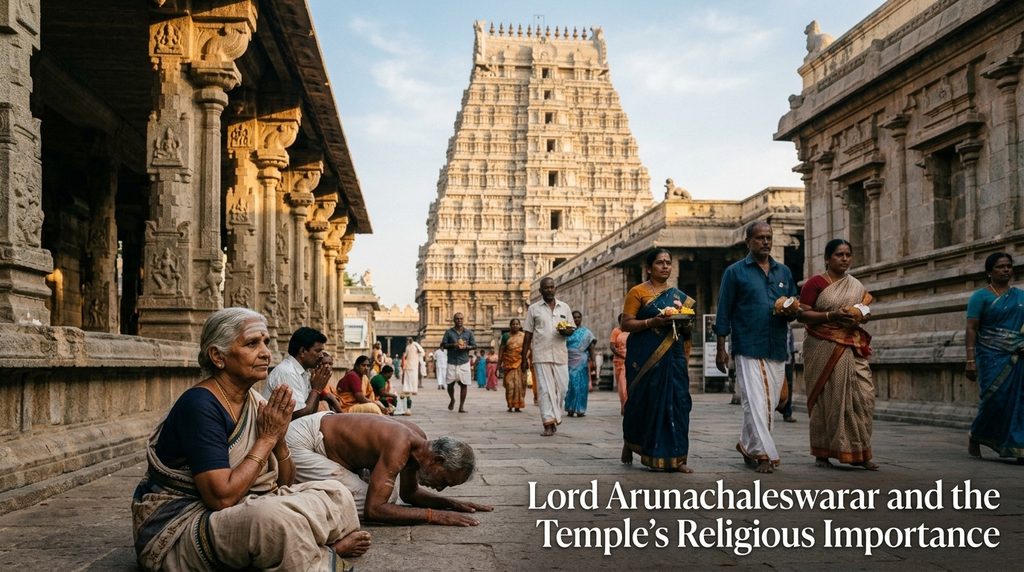
The presiding deity is Lord Shiva, worshipped here as Arunachaleswarar, while Goddess Parvati is worshipped as Unnamulai Amman. Together, these forms lie at the heart of the temple’s ritual and devotional traditions.
The shrine is particularly significant within Tamil Shaivism and is counted among the Pancha Bhoota Sthalas, the five major temples associated with the classical elements. Tiruvannamalai represents Agni, or fire.
For devotees, this is one reason the destination carries such exceptional importance. Worship is connected not only with the deity in the sanctum but also with the sacred identity of the hill and the religious traditions that surround it.
The Architecture Inside the Temple Complex
The complex is among the most striking examples of large-scale Dravidian temple architecture in Tamil Nadu. Monumental gopurams mark its entrances, while pillared halls, shrines, tanks, corridors, and ceremonial spaces reveal the complexity of the site.
The eastern Raja Gopuram is particularly well known and creates a powerful first impression for many visitors. Yet it is worth looking beyond the most photographed gateway. Stone pillars, sculptural details, subsidiary shrines, and the changing scale of different courtyards provide a more complete sense of the temple’s architectural character.
Because this remains an active place of worship, visitors should remember that architecture and ritual function together. Some areas are experienced primarily as sacred spaces rather than as historical exhibits.
Exploring the Major Spaces and Shrines
A visit can feel overwhelming because of the size and complexity of the grounds. Taking time to move through the complex gradually often makes the experience more rewarding.
The Main Shrine
The principal sanctum is dedicated to Arunachaleswarar. Access and movement within worship areas may be subject to temple procedures, so visitors should follow instructions from temple authorities and staff.
Unnamulai Amman Shrine
The shrine of Unnamulai Amman is another important focus of worship. Its presence reflects the broader Shaiva tradition in which the divine forms of Shiva and Parvati are both central to the religious life of the temple.
Temple Tanks and Mandapams
Water bodies and ceremonial halls are integral to South Indian temple design and ritual practice. As you explore, these spaces help explain how worship, festivals, processions, and community life have historically unfolded within the complex.
Girivalam: The Sacred Walk Around the Hill
One of Tiruvannamalai’s most distinctive traditions is Girivalam, the pilgrimage circumambulation of Arunachala Hill. Devotees walk around the hill on the traditional route as an act of worship.
The full circuit is commonly described as being around 14 kilometres, although travelers should remember that conditions on the route, walking pace, crowds, and starting points can affect the experience. The walk is especially popular during full-moon periods, when large numbers of pilgrims may participate.
Girivalam is not a casual sightseeing walk. Visitors should dress modestly, carry drinking water when appropriate, be prepared for substantial time on foot, and remain considerate of devotees using the route for religious purposes.
| Girivalam Planning Point | What Travelers Should Consider |
| Approximate route | Commonly described as around 14 kilometres |
| Purpose | Religious circumambulation of Arunachala Hill |
| Popular periods | Full-moon days can attract very large crowds |
| Preparation | Comfortable walking footwear, water, and adequate time |
| Conduct | Respect the route as an active pilgrimage tradition |
Karthigai Deepam and the Festival Season
The destination becomes particularly dramatic during Karthigai Deepam, one of its most important annual religious celebrations. The festival is associated with the sacred fire tradition of Arunachala, and a great beacon is traditionally lit on the hill as part of the observance.
The festival draws enormous numbers of pilgrims and can transform travel conditions throughout Tiruvannamalai. Accommodation demand rises, roads and public spaces become crowded, and visitors need considerably more patience and advance planning.
For travelers interested in witnessing this major celebration, the experience can be extraordinary. For those seeking a quieter temple visit, choosing another period may be more comfortable. Festival dates follow the religious calendar and vary by year, so current dates should always be confirmed before booking travel.
Best Time to Visit
The cooler months are generally more comfortable for exploring Tiruvannamalai and spending time outdoors, particularly if you plan to walk around the hill or visit other places in the town. The hottest months can make daytime sightseeing and long walks more demanding.
Karthigai Deepam offers one of the most powerful times to experience the town’s religious atmosphere, but it also brings exceptional crowds. Full-moon periods can likewise be busier because of Girivalam.
Travelers looking for a balance between comfortable conditions and manageable crowds may prefer an ordinary period outside major festivals and especially busy pilgrimage dates. Before finalizing plans, it is sensible to check the current temple calendar, local conditions, and festival schedule.
How to Reach Tiruvannamalai
Tiruvannamalai is connected by road and rail to several parts of Tamil Nadu. Chennai and Bengaluru are common starting points for longer journeys, while travelers can also combine a visit with other destinations in the state.
The town has a railway station, and road connections are available through regular bus services and private transport. The most convenient route depends on where your journey begins, so it is better to compare current train and bus schedules before departure rather than relying on outdated travel information.
Once in town, the central temple area is easily integrated into a wider visit, though traffic and crowds can become significant during major religious occasions.
| Travel Option | Practical Use for Visitors |
| Rail | Tiruvannamalai has a railway station with connections that vary by service |
| Bus | Useful for travel from Chennai, Bengaluru, and other Tamil Nadu destinations |
| Private car | Offers flexibility, especially when combining nearby destinations |
| Local transport | Helpful for reaching sites beyond the central temple area |
| Walking | Practical around central areas, depending on weather and crowd levels |
Ramanashramam and Other Nearby Places
Tiruvannamalai offers more than one important spiritual destination. Sri Ramanasramam, associated with the sage Ramana Maharshi, is located near the base of the hill and attracts visitors interested in his teachings and legacy.
Skandashram and Virupaksha Cave are also associated with Ramana Maharshi’s life on Arunachala Hill. Reaching hillside locations may involve walking and conditions can vary, so visitors should consider their physical comfort, weather, and available access before setting out.
These places offer a quieter contrast to the scale and activity of the main temple. Together, they help explain why Tiruvannamalai has remained an important destination for pilgrims, seekers, scholars, and spiritual travelers.
Local Customs and Visitor Etiquette
Respectful conduct matters greatly in an active religious environment. Modest clothing is appropriate, and visitors should follow instructions concerning footwear, photography, queue systems, and access to specific areas.
It is also important not to assume that every part of a sacred complex functions like a tourist attraction. Some spaces are primarily intended for worshippers, and procedures may change during rituals or festivals.
During Girivalam and major celebrations, patience is essential. Avoid obstructing processions, follow crowd-management instructions, and remain aware that local residents and pilgrims may be participating in deeply significant religious practices.
Practical Tips for a Smoother Visit
Arriving with a flexible schedule can make a major difference. Allow extra time for queues, security procedures, traffic, and periods when the complex is especially busy.
If you are visiting during a festival or full-moon pilgrimage period, arrange transportation and accommodation well in advance. Carry essentials suited to the weather, but travel light enough to move comfortably through crowded areas.
Above all, avoid building an overly ambitious itinerary. Tiruvannamalai rewards visitors who leave time to observe, walk, rest, and absorb the atmosphere rather than treating the journey as a list of places to complete.
What Makes Tiruvannamalai Different From Other Temple Towns
Many Indian temple towns are built around a sacred centre, but here the relationship between shrine and landscape is unusually direct. Arunachala Hill gives the entire destination a visual and religious unity that remains evident wherever you go.
The great temple, the circumambulation route, the fire symbolism of Karthigai Deepam, and the area’s association with Ramana Maharshi all contribute to a layered experience. Different travelers may arrive for different reasons, yet the destination does not separate its spiritual identity from its physical setting.
That is perhaps its defining quality. The hill, town, temple, pilgrimage routes, and daily rituals all seem to belong to one continuous sacred geography.
Conclusion
Tiruvannamalai is a destination best experienced with time and attention. Its monumental temple architecture is impressive, but the deeper character of the place emerges through the hill’s religious significance, the traditions of Girivalam, the rhythms of daily worship, and the extraordinary scale of Karthigai Deepam.
A well-planned visit should leave room for more than photographs and sightseeing. Learn the customs before arriving, choose your travel period carefully, and allow the destination’s pace to guide the experience. For travelers interested in South Indian heritage, living religious traditions, and landscapes shaped by centuries of belief, this sacred town offers a journey with genuine depth.
FAQs
Where is the famous Shiva temple in Tiruvannamalai located?
The main shrine stands in the centre of Tiruvannamalai, Tamil Nadu, at the foot of the sacred Arunachala Hill. The town itself is a major pilgrimage destination in South India.
Why is Arunachala Hill considered sacred?
In Shaiva tradition, the hill is associated with Lord Shiva and is regarded as a manifestation connected with the element of fire. Its religious importance is inseparable from the worship and pilgrimage traditions of Tiruvannamalai.
What is Girivalam in Tiruvannamalai?
Girivalam is the traditional practice of circumambulating Arunachala Hill on foot as an act of devotion. The route is commonly described as approximately 14 kilometres and can become particularly crowded on full-moon days.
When is Karthigai Deepam celebrated?
Karthigai Deepam is an important annual festival whose dates follow the Hindu religious calendar and therefore vary each year. Travelers should confirm the current year’s dates before planning a festival visit.
What should visitors wear at the temple?
Modest, respectful clothing is appropriate. Visitors should also follow current instructions regarding footwear, photography, access to worship areas, and any rules announced by temple authorities.

I am a travel enthusiast who loves exploring India’s beautiful destinations, culture, history, food, and hidden places. Through my travel website, I aim to help travelers discover amazing places in India and plan memorable trips with useful travel information and tips.