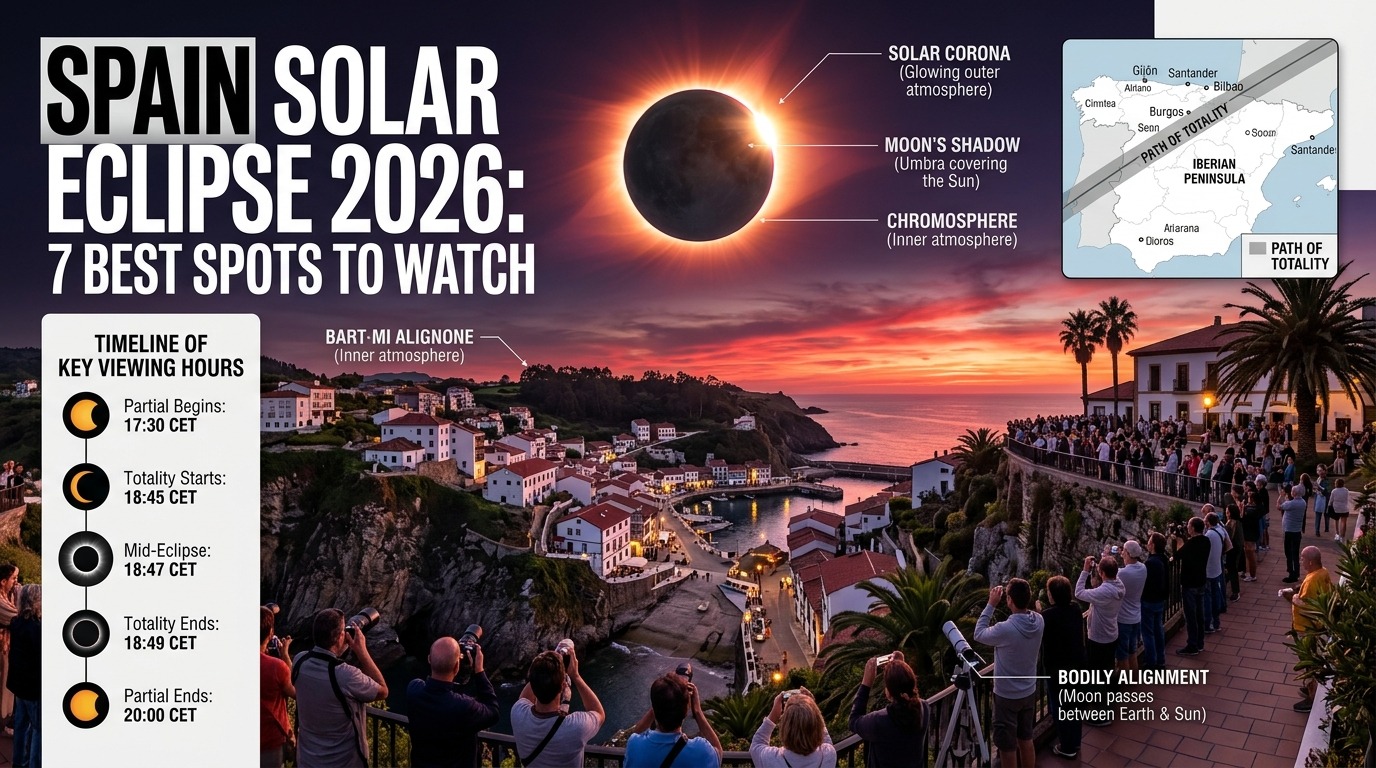
On the evening of August 12, 2026, the sky over northern Spain will do something it hasn’t done in more than a century: go completely dark in the middle of summer. The Spain solar eclipse 2026 marks the first total solar eclipse visible from mainland Spain since 1905, and it’s arriving right as the sun begins to set, which makes the whole event feel even more dramatic than a typical eclipse.
If you’ve never seen a total solar eclipse before, this one is worth planning around. The Spain solar eclipse 2026 will trace a narrow path across the country, and only people standing inside that path will witness true totality, the few precious seconds when the moon fully blocks the sun and the sky turns to twilight. Step outside that path, even by a few kilometers, and you’ll only see a partial eclipse.
This guide covers everything you need to know: where the path goes, exact timing by city, the best places to watch it, and how to view it safely.
Why the Spain Solar Eclipse 2026 Is Such a Big Deal
Total solar eclipses aren’t rare on a global scale, but they’re rare for any single spot on Earth. Most places wait decades, sometimes centuries, between visits from the moon’s shadow.
The Last One Was Over 100 Years Ago
The last total solar eclipse visible from mainland Spain happened on August 30, 1905, following a strikingly similar path across the country. Mainland Europe as a whole hasn’t seen totality since August 11, 1999, when the shadow swept through England, France, and Germany.
A Rare Triad of Eclipses
What makes 2026 even more unusual is that it’s the first of three eclipses to cross Spain within a two-year stretch. A second total solar eclipse follows on August 2, 2027, and an annular eclipse rounds out the trio on January 26, 2028. After that run, the next total solar eclipse visible from Spain won’t happen again until 2053.
It Happens at Sunset
Because Spain sits near the end of the eclipse’s path, the sun will already be low on the horizon when totality arrives, somewhere between 2 and 12 degrees above the horizon depending on location. That low angle means observers need a clear, unobstructed view toward the west, which shapes a lot of the viewing advice below.
The Path of the Spain Solar Eclipse 2026
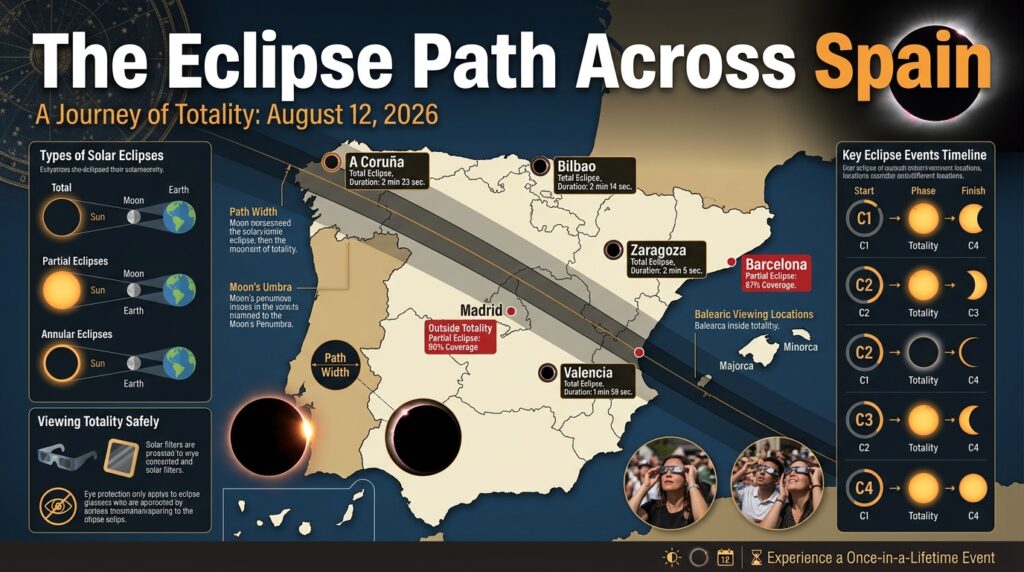
The path of totality enters Spain from the northwest and exits over the Mediterranean, crossing a wide swath of the country’s northern half.
Where the Path Crosses
The shadow moves from Galicia on the Atlantic coast, through Asturias, Castilla y León, the Basque Country, Aragón, and the Valencia region, before ending its journey over the Balearic Islands. Cities that fall inside the path include Coruña, Oviedo, León, Bilbao, Santander, Burgos, Zaragoza, Valencia, and Palma de Mallorca.
Cities That Just Miss It
Not every major Spanish city is so lucky. Madrid and Barcelona sit just outside the path of totality, meaning residents there will see a deep partial eclipse of around 99.9 percent obscuration, but not the full experience. Given that these two cities are home to roughly 12 million people combined, expect heavy travel toward the path of totality as the date approaches.
How Wide Is the Path
The path of totality across Spain is roughly 290 kilometers wide, which gives travelers some flexibility in choosing a viewing location without having to hit one exact pinpoint.
Exact Timing for the Spain Solar Eclipse 2026
Timing shifts slightly as the shadow moves from west to east across the country, so it helps to know roughly what to expect wherever you’re headed.
Galicia and the Atlantic Coast
In A Coruña, the partial phase begins around 19:31 local time, with totality arriving near 20:26 to 20:28 and lasting a little over a minute. Sunset follows shortly after, around 21:41.
Central and Northern Spain
Cities like Burgos, León, and Bilbao will see totality begin a minute or two after Galicia, generally falling between 20:28 and 20:31 local time, with the sun sitting noticeably lower in the sky by that point.
Valencia and the Eastern Coast
In Valencia, totality lands around 8:32 p.m., lasting roughly 60 to 70 seconds, with the full partial eclipse stretching from about 7:38 p.m. to 9:01 p.m., right around sunset.
The Balearic Islands
Palma de Mallorca is one of the last stops along the path, with totality arriving near 20:32 local time. Because the sun will be just a couple of degrees above the horizon here, a flat, unobstructed western view is essential.
Best Places to Watch the Spain Solar Eclipse 2026
Since Spain is one of the most mountainous countries in Europe, finding a clear line of sight to the low western sun takes some planning.
Picos de Europa, Asturias
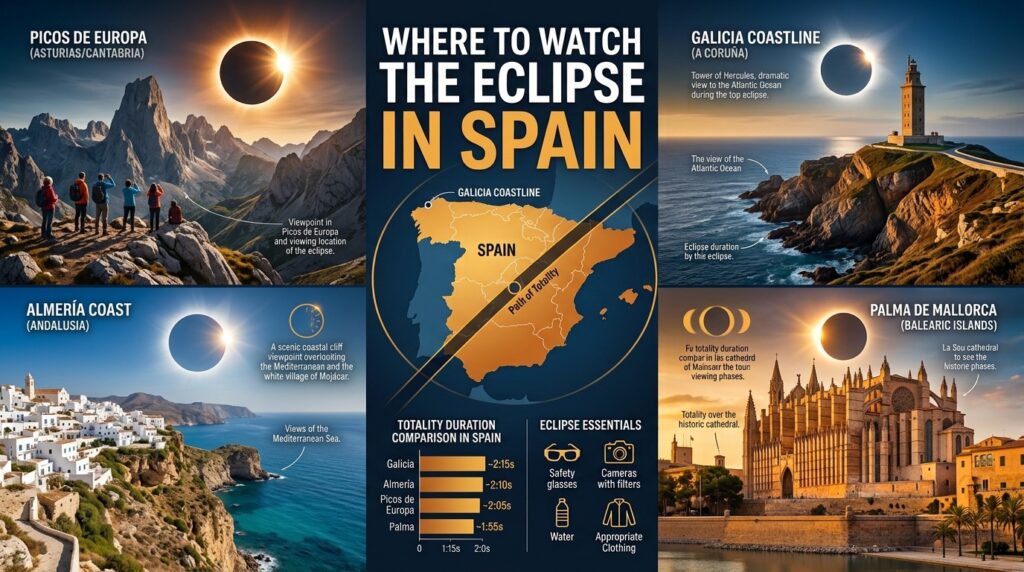
High viewpoints like Pico de la Tabla offer dramatic mountain scenery along with roughly 1 minute 43 seconds of totality, though the sun will sit fairly low at around 9 degrees above the horizon.
Tower of Hercules, A Coruña
This Roman-era lighthouse on Galicia’s northwest coast gives an open, oceanfront vantage point, which is ideal given how low the sun will already be when totality begins.
Sigüenza, Guadalajara
This historic town offers open sightlines along with cobbled streets and a centuries-old cathedral, making it a good pick for travelers who want scenery beyond just the sky.
Aras de los Olmos and the Valencia Region
Valencia’s regional government has designated official viewing sites, including a Starlight-certified dark sky reserve in the interior and Puçol beach closer to the capital, both chosen for open horizons and easy access.
Ebro Delta, Tarragona
This wetland nature reserve is one of the few spots along Spain’s eastern coast with a genuinely clear sightline to the setting, eclipsed sun.
Palma de Mallorca
Between the cathedral, coastal miradors, and boat tours into the bay, Palma offers several ways to combine sightseeing with eclipse viewing, though totality here will be brief.
How to Watch the Spain Solar Eclipse 2026 Safely
Eclipse viewing is genuinely safe when done correctly, but it requires the right equipment and a bit of common sense.
Eclipse Glasses Are Non-Negotiable
Throughout the entire partial phase, before and after totality, viewers must use ISO 12312-2 certified eclipse glasses. Regular sunglasses, no matter how dark, do not offer enough protection.
The Brief Window When It’s Safe to Look Directly
Only during the short window of full totality, when the moon completely covers the sun’s disk, is it safe to remove the glasses and look with the naked eye. The moment any sliver of sunlight reappears, glasses need to go back on immediately.
Never Use Unfiltered Optics
Cameras, binoculars, and telescopes all need proper solar filters. Looking through unfiltered optics, even briefly, can cause serious eye damage.
Check the Weather Forecast Closely
August tends to be dry across much of Spain, though conditions vary by region. The Mediterranean coast around Valencia typically has better odds of clear skies than the Atlantic coast near Galicia and Bilbao, so it’s worth watching regional forecasts as the date approaches.
A Bonus for Stargazers
The Spain solar eclipse 2026 lands on the same night as the peak of the Perseid meteor shower. Once darkness falls and the new moon leaves the sky free of moonlight, conditions for meteor watching afterward are unusually good, adding a second reason to stay out late on August 12.
FAQs
What time will the Spain solar eclipse 2026 happen?
Totality moves across the country between roughly 20:26 and 20:32 local time on August 12, 2026, depending on location, with the whole event happening close to sunset.
Will Madrid or Barcelona see the total eclipse?
No. Both cities sit just outside the path of totality and will see a partial eclipse of around 99.9 percent obscuration rather than full darkness.
How long will totality last during the Spain solar eclipse 2026?
Duration varies by location, generally ranging from about one minute in cities like Valencia to a little over a minute and a half in parts of Galicia and the Balearic Islands.
Do I need special glasses to watch the eclipse?
Yes. ISO 12312-2 certified eclipse glasses are required throughout the partial phases. Naked-eye viewing is only safe during the brief window of full totality.
When is the next total solar eclipse in Spain after 2026?
Spain will see another total solar eclipse on August 2, 2027, followed by an annular eclipse on January 26, 2028. After that, the next total eclipse won’t occur until 2053.
Conclusion: Don’t Miss This Once-in-a-Century Event
The Spain solar eclipse 2026 is not something that repeats on a convenient schedule. This is the first time mainland Spain has seen totality in over 100 years, and while two more eclipses follow in 2027 and 2028, the next full total eclipse after that trio won’t arrive until 2053. Whether you’re planning to watch from a mountain peak in Asturias, a beach in Valencia, or a rooftop in Palma, the key is getting inside the path of totality and having a clear western horizon when the sun starts to disappear.
Read More: 9 Dreamy Luxury Honeymoon Destinations for 2026