Packing for a trip always sounds simple until you’re sitting on your suitcase at midnight trying to get the zipper closed. If you’ve ever landed somewhere with a dead phone, a wrinkled shirt, or a bag that weighs more than the airline allows, you already know why the best travel accessories matter more than people think.
This isn’t a list of random gadgets pulled off a shopping site. It’s built around the stuff that actually earns a spot in a carry on trip after trip. Some of these items save space. Others save money. A few just save your sanity at 6 a.m. in a crowded terminal.
By the end of this guide, you’ll know exactly which accessories are worth buying, which ones to skip, and how to build a kit that works whether you’re going away for a weekend or three weeks.
Why Travel Accessories Matter More Than People Think
A lot of travelers assume accessories are optional extras. In reality, the right gear changes how a trip feels from the first hour to the last.
Travel accessories aren’t new, luggage itself has changed a lot over the decades.
Think about the difference between digging through a messy backpack for a charging cable and reaching into a labeled pouch and grabbing it in two seconds. That small moment adds up over a whole trip.
Good travel accessories do three things well. They protect your belongings, they save physical space, and they cut down on the small frustrations that drain your energy while you’re away from home.
The Real Cost of Skipping the Right Gear
Skipping proper gear usually costs more later. A cheap adapter that fails in a foreign outlet, a bag that won’t fit overhead, or a charger that dies mid-flight can turn a good trip into a stressful one.
Spending a little upfront on the best travel accessories for your specific trip style almost always pays for itself, especially on longer trips or international routes where replacing something isn’t as easy as running to the nearest store.
How to Choose Accessories That Fit Your Trip
Not every accessory suits every traveler. A business trip needs different gear than a backpacking route through Southeast Asia.
Before buying anything, ask what kind of trip you take most often. Frequent flyers benefit from noise cancelling headphones and compression packing cubes. Road trippers get more value from car organizers and offline navigation tools. Matching gear to your actual travel pattern is what separates a useful kit from a drawer full of unused gadgets.
Packing Accessories Worth Buying
Packing is where most travelers waste the most time, so this is where good accessories make the biggest difference.
Packing Cubes
Packing cubes are probably the single most recommended item on any list of the best travel accessories, and for good reason. They compress clothing, keep categories separated, and make unpacking at a hotel almost instant.
A set with a mix of sizes works better than uniform cubes. Use larger ones for tops and bottoms, smaller ones for underwear and socks, and a flat one for anything that needs to stay wrinkle free.
A Digital Luggage Scale
Airlines charge steep fees for overweight bags, and guessing your bag’s weight at the counter is a bad strategy. A compact digital luggage scale clips onto a handle, gives a weight reading in seconds, and costs less than a single overweight baggage fee.
Compression Bags for Bulky Items
For anyone packing jackets, sweaters, or bedding for a longer stay, compression bags remove the air and shrink bulky items down to a fraction of their original size. They’re especially useful for winter trips or when packing gear for multiple climates in one bag.
Tech Accessories Every Traveler Should Carry
Technology keeps a trip running smoothly, from checking in online to navigating a new city, so this gear deserves real thought instead of an afterthought purchase at the airport.
A Portable Power Bank
A dead phone in an unfamiliar city is more than an inconvenience, it can turn into a genuine safety issue if you can’t pull up a map or call for a ride. A power bank with at least 10,000 mAh capacity covers a full day of heavy phone use, and one with two ports lets you charge a phone and a set of earbuds at the same time.
A Universal Travel Adapter
Outlet shapes vary by country, and a single universal adapter with USB ports built in removes the need to carry several separate plugs. Look for one with surge protection, since power quality varies more than most travelers expect.
Noise Cancelling Headphones
Long flights and busy terminals are easier to handle with a good pair of noise cancelling headphones. Beyond blocking engine noise, they help travelers sleep on overnight flights and stay focused while working from an airport lounge.
Comfort Accessories for Long Flights
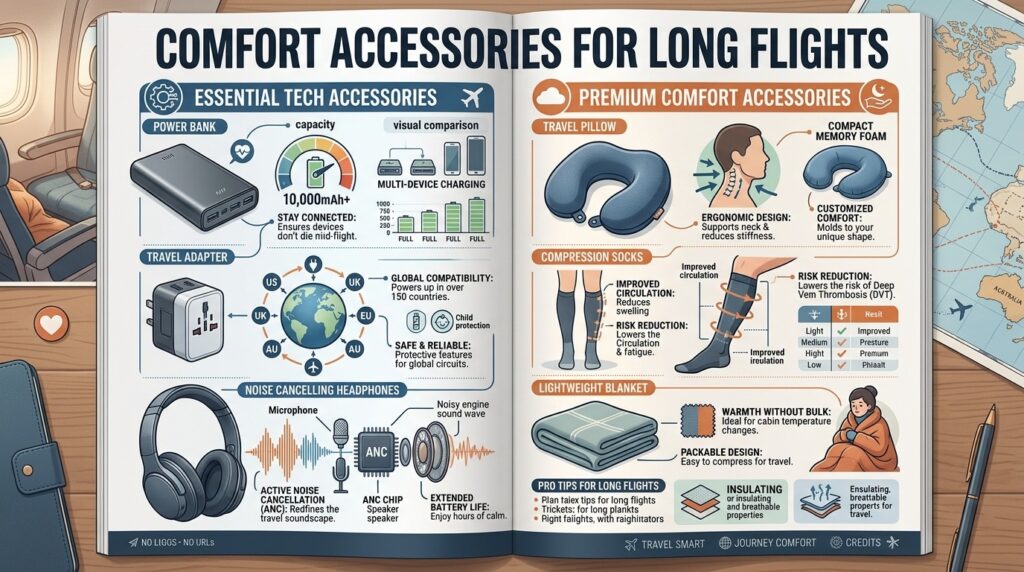
Comfort accessories don’t get as much attention as tech gear, but anyone who has done a red-eye flight knows how much they matter.
A Supportive Travel Pillow
Skip the inflatable rings that never quite hold their shape. A memory foam travel pillow with a wraparound design supports the neck properly and compresses down for easy storage in a carry on.
Compression Socks
Long haul flights increase the risk of swelling and discomfort in the legs. Compression socks improve circulation and make a noticeable difference on flights over five hours, especially for travelers who already deal with leg fatigue.
A Lightweight Travel Blanket
Airplane cabins run cold more often than not, and airline blankets are thin at best. A compact, lightweight travel blanket that folds into its own pouch takes up minimal space and adds real comfort on long routes.
A high-impact visually bold educational magazine-style image. The image illustrates essential tech accessories like a power bank, travel adapter, and noise cancelling headphones alongside comfort accessories such as a travel pillow, compression socks, and a lightweight blanket. Include clearly labeled visual elements, infographic blocks, icons, visual comparisons, educational callouts, and modern typography. The large headline text reads “Tech and Comfort Accessories for Every Trip.” Professional color palette, premium editorial design, photorealistic imagery combined with infographic elements, high-resolution quality, visually engaging and easy to understand. No logos. No URLs.
Security and Organization Accessories
Losing a passport or having a bag tampered with can derail an entire trip, so a few security focused accessories are worth the small investment.
An RFID Blocking Wallet or Passport Holder
Contactless card skimming is a real risk in crowded tourist areas. An RFID blocking wallet or passport holder blocks unauthorized scans and keeps your passport, cards, and boarding pass organized in one place.
A TSA Approved Luggage Lock
A simple combination lock that TSA agents can open without cutting it protects checked luggage from casual tampering while keeping you compliant with security screening requirements.
Anti-Theft Crossbody Bag
For city exploring, an anti-theft crossbody bag with slash resistant straps and hidden zippers gives peace of mind in busy markets, train stations, and tourist hotspots where pickpocketing is more common.
Practical Extras That Make a Real Difference
A few smaller items round out a solid travel kit without adding much bulk.
A Portable Luggage Tracker
A small Bluetooth tracker clipped to a checked bag lets you follow its location through your phone, which is especially reassuring on connecting flights where lost luggage is more likely.
Reusable Toiletry Bottles
Reusable, leak proof toiletry bottles keep favorite products within carry-on liquid limits without buying travel sized versions every trip, saving money over time.
How to Build Your Own Travel Accessory Kit
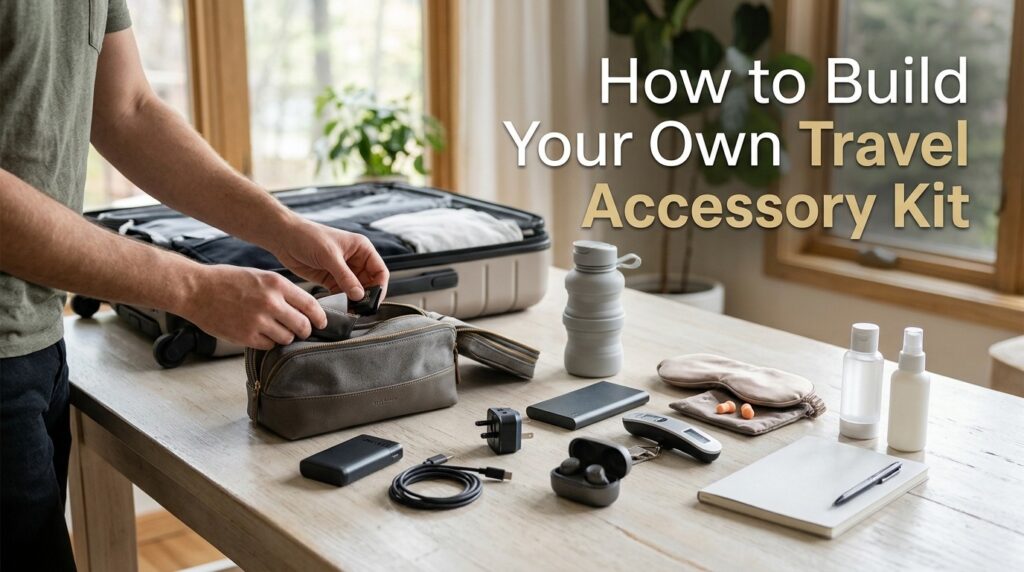
Rather than buying every item on this list at once, start with the accessories that solve your biggest travel frustration first.
If dead batteries are your main issue, start with a power bank. If you struggle with overweight bags, start with a luggage scale and compression bags. Build the kit gradually and you’ll end up with gear you actually use instead of items sitting untouched in a drawer.
A good rule of thumb: pick one item from each category above, packing, tech, comfort, and security. That combination covers most travel scenarios without overloading your luggage.
FAQs
What are the most essential travel accessories to buy first?
A portable power bank, packing cubes, and a universal travel adapter cover the most common travel problems and are a smart starting point for any new travel kit.
Are packing cubes really worth it for short trips?
Yes, even for a weekend trip packing cubes keep clothing organized and compressed, making it easier to fit everything into a smaller carry on bag.
What travel accessory helps the most on long flights?
A supportive travel pillow combined with noise cancelling headphones makes the biggest difference in comfort and sleep quality during long haul flights.
Do I need an RFID blocking wallet for international travel?
An RFID blocking wallet is a low cost way to protect against contactless card skimming, which is more common in crowded tourist areas and public transit systems abroad.
How many travel accessories should I pack for a two week trip?
Focus on one or two items per category, packing, tech, comfort, and security, rather than packing every accessory available, to avoid unnecessary bulk and weight.
Conclusion
The best travel accessories aren’t about buying the most expensive gadgets on the market. They’re about solving the specific problems that make travel harder than it needs to be, whether that’s a dead phone, a wrinkled shirt, or a sore neck after a long flight.
Start small, focus on the categories that match how you actually travel, and build your kit over time. A few smart choices now mean fewer headaches on every trip that follows.
Read More: 9 Best Toiletry Bags That Make Packing Effortless

I am a travel enthusiast who loves exploring India’s beautiful destinations, culture, history, food, and hidden places. Through my travel website, I aim to help travelers discover amazing places in India and plan memorable trips with useful travel information and tips.